Showing posts with label Warren Beatty. Show all posts

Monday, April 24, 2017

Rules Don't Apply

One of the many starlets (Lily Collins) on Howard Hughes's payroll lives by the stringent rules accorded by the aging, shadowy, and eccentric billionaire (Warren Beatty), which includes not dating your assigned driver and personal spy, in her case a straight-edged, business driven Christian (Alden Ehrenreich). Beatty's self-aggrandizing, first directorial effort in almost twenty years is a strange, tonally shifting, and shamefully bad screwball comedy that only conjures up memories of Scorsese's The Aviator, a vastly superior Hughes picture. Only Ehrenreich keeps the picture afloat.
* out of ****

Thursday, February 13, 2014

McCabe & Mrs. Miller

(spoilers herein) An arrogant cardsharp (Warren Beatty) opens a gambling joint in an upstart western mining city so young that it barely has the frames of its houses filled it. When a beautiful, classy prostitute (Julie Christie) convinces him he needs her expertise to oversee his whorehouse, he finds in her both a business partner and an awkward lover. However, when his bustling operation comes to the attention of a large mining company, whose negotiating agents he refuses to play ball with, McCabe finds his livelihood and personal well being in the hands of a ruthless band of mercenaries. With its beautifully lit photography, very human performances from Beatty and Christie, and a screenplay interested foremost in the sociological behavior of its characters, Robert Altman's McCabe & Mrs. Miller is a western that is so distinct and well-defined, it places itself in a class apart from other entries in the genre. It also features several haunting icy demises, namely the finale and Keith Carradine's senseless, unforgettable rope bridge execution.

Friday, April 5, 2013

Bonnie and Clyde

The film world lost a giant yesterday. Despite the fact that he never directed or starred in a picture (he did write the screenplays for "Beyond the Valley of the Dolls" and "Up!", two Russ Meyer B movies), Roger Ebert was as influential as anyone in the industry, authoring thousands of reviews in a career spanning over forty years. He instilled a love of film in millions due to an intelligent, perceptive, unpretentious, and non-caustic style that celebrated the joy in cinema, focusing on the good, not the bad aspects of movies. "Bonnie and Clyde" was one of his most famous and influential reviews, and also one of his first. It helped get the initially untouted film seen, put out to pasture the moralizing old guard approaches to criticism, and usher in a new era of unbounded creativity in moviemaking. Follow the link to find his original 1967 review.

Rest in Peace Roger, your absence will be known.

Here are my thoughts on the great classic:
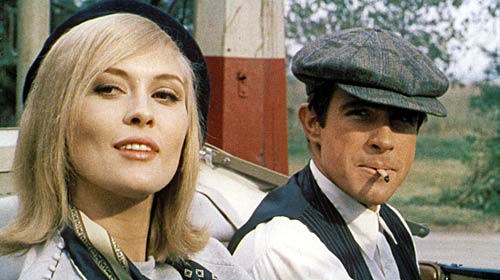
(8/10/11) As she changes in her room, Bonnie Parker glances out of the window and notices a young man attempting to steal her mother's car. She runs out to stop the man and is immediately attracted to his handsome charm and reckless nature. Clyde Barrow then takes her into town where he robs a grocery and steals a car and she is immediately hooked. Becoming her partner in crime, the two engage on a spree in the southwest where they rob banks and take on a mythic Robin Hoodlike image. Teaming up with a dimwitted mechanic, Clyde's brother Buck and his wife, the two head down a wild and dangerous road that can only end in tragedy. Director Arthur Penn's "Bonnie and Clyde" is a romanticized version of the famed outlaws. When released common folk authority scorning heroes struck a chord with counterculture film goers while startling many with its images of stark violence. Working from a script by David Newman, Robert Benton, and Robert Towne, the film contains wonderful direction by Penn, great editing by Dede Allen, and superb Oscar winning Technicolor cinematography by Burnett Guffey. Warren Beatty and Faye Dunaway share perfect chemistry in two roles for the ages and they are given wonderful support. Michael J. Pollard is wonderfully dopey as C.W. Moss, their idiot mechanic. Gene Hackman is great as Clyde's good old boy brother Buck. Estelle Parsons is wonderful in an Oscar winning role as Buck's flighty wife Blanche, and Gene Wilder, in his debut film, has a hilarious and ominous bit part as an undertaker the gang kidnaps. "Bonnie and Clyde" is a modern classic that changed both how heroes and violence were presented in mainstream movies, and at its most basic level, is a sublime example of filmmaking.

Tuesday, July 10, 2012

Heaven Can Wait

The environmentally conscious, dimwitted quarterback for the L.A. Rams is involved in a traffic accident just days before the Super Bowl when his guardian angel jumps the gun, and transports his soul from his body. Having been swindled of his longevity, the QB is now given another chance at life as a recently murdered, but not yet collected, tycoon. "Heaven Can Wait" is an almost by the numbers remake of "Here Comes Mr. Jordan" and like its hero Joe Pendleton, it is a not too bright but very likable motion picture. Cowriting (with Elaine May), Codirecting (with Buck Henry - who plays his guardian angel), producing, and starring, Warren Beatty does a pretty stellar job of putting all the pieces together and crafting an enjoyable feature. Many of the colorful supporting roles are filled nicely: James Mason is excellent in the Mr. Jordan role, the executive in charge of the angels. Jack Warden is also great as Beatty's football coach and I also enjoyed Charles Grodin as his murderous yet feeble secretary. The women seemed miscast here. The lovely Julie Christie is off as the love interest and Dyan Cannon (who received an Oscar nod) seems to be hitting the wrong notes as Beatty's treacherous wife. There's virtually zero moments of inspiration or originality in "Heaven Can Wait". Instead, Beatty reworks a time tested movie into another enjoyable one.
*** out of ****

Saturday, February 11, 2012

The Parallax View

A Seattle journalist is denied access to the Space Needle where a conference with the Senator is taking place when the guest of honor is murdered. As the government committee declares the assassination to be the work of a lone gunman, the journalist's ex-girlfriend/colleague visits him in terror of being murdered as other witnesses to the crime are being mysteriously eradicated. When she turns up dead a few days later, the brazen reporter launches his own investigation which leads him to the abstruse Parallax corporation and, which goes without saying, way over is head. Two years before creating his political thriller classic "All the President's Men" and during the Watergate scandal that provided the basis for that film, director Alan J. Pakula crafted another outstanding, paranoid yet not as successful film based on another landmark event in U.S. history. Using the JFK assassination and the Warren Commission as a springboard, "The Parallax View" brings terrifying believability to ludicrous scenarios. Filmed much in the same manner as "ATPM", Pakula uses slow burn tension and minute detail to concoct an absorbing story. Warren Beatty is brash and cheeky and absolutely perfect for his role as the hero/patsy. I personally do not subscribe to conspiracy theories but Pakula's film does an excellent job of showing how the puzzle pieces can be arranged to form an entirely different picture.

Friday, July 29, 2011

Shampoo

On Election Day 1968, a Los Angeles hairdresser (Warren Beatty) tries to secure a bank loan for his own salon while pleasing his girlfriend (Goldie Hawn) and the wife (Lee Grant), mistress (Julie Christie), and daughter (Carrie Fisher) of a prospective investor (Jack Warden). Directed by the great 70s director Hal Ashby and written by Chinatown scribe Robert Towne and Beatty, contains a slew of great performances from a spectacular cast with the underappreciated character actor Warden tremendous here as well as Grant in an Oscar winning performance. Shampoo is a muddled movie that strives to be a satire, lamenting the loss of 1960s innocence as well as the Nixon administration which would have been timely as the movie was released shortly after the Watergate scandal. Although I feel it falls short as satire, the film really comes together nicely in its final third and ends with a wonderfully realized finale. This, along with the performances, make the film worth seeing.