Showing posts with label 1967. Show all posts

Friday, April 7, 2017

The Two of Us

During the German Occupation, the Jewish parents of an exuberant juvenile (Alain Cohen) determine it would be safer for all involved if he were to live in the country under an assumed name where a bond quickly develops with the kind and curmudgeonly, anti-semitic elderly shelterer (Michel Simon). Claude Berri's autobiographical ode to his wartime protectors is moving and humorous, with a great performance from Simon and a natural one from Cohen, and tells a story, the likes of which would never even be dreamt of being attempted in today's PC climate.
*** 1/2 out of ****

Monday, February 20, 2017

Camelot

Lerner and Loewe's musical rendering of the Arthurian Legend features winning performances from Richard Harris (Arthur) and Vanessa Redgrave (Guenevere) amidst tacky production design with a pace that dies in the second act of a long affair.
*** out of ****

Wednesday, January 25, 2017

Samurai Rebellion

A feudal lord orders his mistress, a source of vexation, out of his house and into marriage with the son of a contented subject (Toshiro Mifune). When the lord changes his mind and orders the woman back, father and son (who is now happily married) must decide whether to accept the decision or take the deadly turn against the unjust act. Maski Kobayahi's Samurai Rebellion is a touching tale of pride, love, and loyalty,  uniquely and effectively edited, with an older, more restrained Mifune still demonstrating much power.
*** 1/2 out of ****

Thursday, July 7, 2016

Playtime

Bumbling Mr. Hulot (Jacques Tati) meanders around a modern, lifeless Paris, encountering tourists, locals, and other mirrors of himself at an office building and a trade show. Tati's Playtime is an impressive concoction, with expansive set pieces that play out like an ever evolving Rube Goldberg machine but is meandering and self-indulgent, similar to sentiments I had toward his equally regarded Mon Oncle. Again, the canvas is spectacular and easy to get lost in but it seems that the prevailing attitude is that composition is enough to hold viewer interest, and if that is the case, what essentially separates this from a Michael Bay movie?
*** out of ****

Tuesday, April 12, 2016

Point Blank

Double crossed and left for dead, a determined man (Lee Marvin) goes up the increasingly treacherous mob ladder, not so much to retrieve his stolen loot, but to exact retribution. John Boorman's Point Blank (remade as Payback with Mel Gibson) is a cold revenge thriller depicting shocking violence with a taciturn Marvin erupting in anger. The picture is well-made and superbly edited, with Carroll O'Connor and John Vernon playing effective baddies. Although it's a film of its time, even dated, it still garners respect today and has to be one of the more continually influential flicks of the period.
*** out of ****

Friday, February 19, 2016

The President's Analyst

A renowned psychiatrist (James Coburn) is tapped to treat the leader of the free world but is made a target by government agents and a victim of extreme paranoia as soon his duties have been completed. The President's Analyst is an odd, trippy satire. Marred by its psychadelia, it has unflatteringly dated and Coburn gives a performance that is equally broad and strange. Some humorous moments do arise, particularly with a suburban New Jersey family with whom Coburn makes his escape.
** 1/2 out of ****

Friday, December 11, 2015

The Firemen's Ball

Disaster strikes at every turn as a group of small town fireman ineptly prep for their annual gala. Milos Forman’s The Fireman’s Ball is a funny, sly critique of the Czech communist regime, made with distinctive, memorable types, outlandish situations, and brilliant photography and direction, and also the reason its overseer had to leave his homeland.
*** out of ****

Monday, September 7, 2015

Eric Rohmer's Six Moral Tales

When the New Wave landed on shores of France and rocked world cinema, Eric Rohmer quietly but intently observed the work of his contemporaries from the Cahiers du Cinema offices where he worked as an editor. There he plotted a series of ostensibly related films, all dealing with a middle class protagonist's responding to a temptress, which were filmed over the period of a decade, and were grouped together as the Six Moral Tales.

The Bakery Girl of Monceau (1963) is a short two reeler, simple, offbeat, talky, icy, and beautifully shot, effectively setting the tone for the entire series. Featuring future directors Barbet Schroeder in the lead and Bernard Taverneier as narrator, it tells the story of a young attorney who makes increasingly frequent visits to a neighborhood confectionery to encounter the title clerk.
*** 1/2 out of ****
Suzanne's Career (1963) followed, and is an intelligent and incredibly prescient, here detailing a woman coming in between the friendship of two friends, one a skirt chaser the other a bashful introvert.
*** 1/2 out of ****
La Collectionneuse (1967) was the first feature film realeased in the series but was actually intended as the fourth tale, bumped up on the shooting schedule when Rohmer failed to achieve weather effects and postponed My Night with Maud. It tells an idyllically set and beautifully shot story of cruel intellectualism about two friends vacationing on the Riveria who find their vacation impeded by a promiscuous guest. 
*** 1/2 out of ****
My Night with Maud (1969) may be the best known of the lot and is my candidate for the finest realization in an unrivaled program. An uptight intellectual bumps into an old friend around the holidays, is invited for dinner to a recently divorced knock-out's chateu, where the two wind up alone, discussing love and philosophy before getting down to business. Perceptive, crisply filmed, and wonderfully acted
*** 1/2 out of ****
Claire's Knee (1970) involves a diplomat on vacation and awaiting marriage who, while visiting with an ex-lover, becomes obsessed with the idea of caressing his landlady's stepdaughter's knee. 
This fifth entry is somewhat creepy, but again retains the film values of its predecessors and remains very watchable
*** 1/2 out ****
Chloe in the Afternoon (1972) concluded the series and, true to form, is involving, low key, and dialogue heavy. Its plot revolves around a happily married Parisian lawyer who hopelessly pursues a bohemian seductress.
*** 1/2 out of ****

Wednesday, January 8, 2014

Belle de Jour

A beautiful upper class housewife (Catherine Deneuve) takes no satisfaction in her perfectly eligible doctor husband and often drifts into bizarre masochistic daydreams. One day she stumbles into a bordello and, after some cajoling from the madame, decides to spend her afternoons as a prostitute while her husband is away at work. Luis Bunuel's Belle de Jour is a bold tour de force, shot in sumptuous technicolor, that features a continuous succession of masterful vignettes, both real and imagined, that all add up to one unique, extraordinary whole. Deneuve, who was at the peak of her unsurpassed beauty, delivers a daring and commanding performance.

Monday, September 23, 2013

Dont Look Back

Don't Look Back is D.A. Pennebaker's coverage of Bob Dylan's 1965 concert tour of Britain, where the documentarian was granted what appears to be total access to the iconic folk singer at the apex of his popularity (and on the cusp of his much maligned shift to electric). This grainy, incredibly photographed film features great concert footage and offers an otherwise unflattering portrait of Dylan who, whether humiliating reporters, evading their questions, or acting rude to hotel workers or his coterie, comes off as smarmy, petulant, and irritating.

Monday, September 16, 2013

Elvira Madigan

Elvira Madigan was a tightrope walker in the late 1800s who ran off with a Swedish military officer and attempted to live simply in the Dutch countryside before realizing the harsh societal truths and deciding their ultimate fate. Director Bo Widerberg seems contented here with his luminous photography, which is gorgeous and was highly praised in its day, but lacks a narrative thrust or anything else really that would make this stilted period piece of interest.

Tuesday, July 23, 2013

Who's That Knocking at My Door

A young man (Harvey Keitel) wanders aimlessly with his buddies through the streets of New York. His thoughtfulness and intelligence are revealed however during a trip to the country and when he meets a nice young girl (Zina Bethune) on the Staten Island Ferry, dishing to her on John Ford's The Searchers and his other favorite films. The two begin a courtship which is forever adulterated when she reveals to him that she had once been raped, a fact he cannot come to terms with. Who's That Knocking at My Door was the autobiographical directorial debut of Martin Scorsese and a drum roll to Mean Streets, its pseudo sequel that announced the whirlwind director to the world. Shot on a shoestring and beleaguered by distribution problems, WTKAMD nonetheless contains Scorsese's trademark themes, techniques, and naturalistic film aptitudes that capture an engrossing, extremely personal story. Keitel, who was also making his film debut, delivers a sublimely emotive lead performance.

Friday, July 12, 2013

In Cold Blood

On a cold November morning in 1959, an upstanding farmer, his wife, and two teen-aged children were found brutally murdered in their homes, the results of a botched home invasion, sending fear through the hearts of their small Kansas town and shock waves across the nation. Based on Truman Capote's real-life crime novel, In Cold Blood follows the manhunt, apprehension, trial, conviction, and execution of the two ex-cons responsible for the crimes, interspersed with flashbacks of their backgrounds and scenes from their brief getaway. Like Capote's novel, director Richard Brooks' adaptation builds his work on detailed realism, filming on many of the actual locations, presenting his film as a docudrama. It is starkly shot in black and white, incredibly edited, features an excellent performance from Robert Blake, and is only slightly diminished by the weighty narration of the Capote fill-in.

Thursday, April 11, 2013

Cool Hand Luke

In a drunken, late night stupor, Luke Jackson (Paul Jackson) is arrested for cutting the tops off of a row of parking meters and sentenced to hard time in the prison chain gang. There his rebellious spirit makes him a favorite among the inmates and a target of the sadistic warden, who makes the escape inclined Luke a target of his brutality. Stuart Rosenberg's "Cool Hand Luke" features Newman's incomparable, iconic performance in a well-made film that often indulges in an overuse of symbolism. George Kennedy, an Oscar winner for a supporting performance I thought was aces as a kid, now seems screening gnashingly over the top while Jo Van Fleet is quite good in a one scene performance as Newman's sickly mother. It also must be said that viewing this alongside "I Am a Fugitive from a Chain Gang", Rosenberg's film owes much to that 1932 Paul Muni classic, which was likewise released by Warner Brothers.

Friday, April 5, 2013

Bonnie and Clyde

The film world lost a giant yesterday. Despite the fact that he never directed or starred in a picture (he did write the screenplays for "Beyond the Valley of the Dolls" and "Up!", two Russ Meyer B movies), Roger Ebert was as influential as anyone in the industry, authoring thousands of reviews in a career spanning over forty years. He instilled a love of film in millions due to an intelligent, perceptive, unpretentious, and non-caustic style that celebrated the joy in cinema, focusing on the good, not the bad aspects of movies. "Bonnie and Clyde" was one of his most famous and influential reviews, and also one of his first. It helped get the initially untouted film seen, put out to pasture the moralizing old guard approaches to criticism, and usher in a new era of unbounded creativity in moviemaking. Follow the link to find his original 1967 review.

Rest in Peace Roger, your absence will be known.

Here are my thoughts on the great classic:
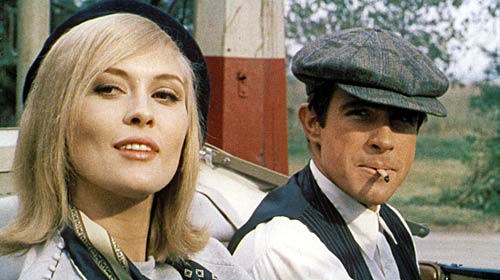
(8/10/11) As she changes in her room, Bonnie Parker glances out of the window and notices a young man attempting to steal her mother's car. She runs out to stop the man and is immediately attracted to his handsome charm and reckless nature. Clyde Barrow then takes her into town where he robs a grocery and steals a car and she is immediately hooked. Becoming her partner in crime, the two engage on a spree in the southwest where they rob banks and take on a mythic Robin Hoodlike image. Teaming up with a dimwitted mechanic, Clyde's brother Buck and his wife, the two head down a wild and dangerous road that can only end in tragedy. Director Arthur Penn's "Bonnie and Clyde" is a romanticized version of the famed outlaws. When released common folk authority scorning heroes struck a chord with counterculture film goers while startling many with its images of stark violence. Working from a script by David Newman, Robert Benton, and Robert Towne, the film contains wonderful direction by Penn, great editing by Dede Allen, and superb Oscar winning Technicolor cinematography by Burnett Guffey. Warren Beatty and Faye Dunaway share perfect chemistry in two roles for the ages and they are given wonderful support. Michael J. Pollard is wonderfully dopey as C.W. Moss, their idiot mechanic. Gene Hackman is great as Clyde's good old boy brother Buck. Estelle Parsons is wonderful in an Oscar winning role as Buck's flighty wife Blanche, and Gene Wilder, in his debut film, has a hilarious and ominous bit part as an undertaker the gang kidnaps. "Bonnie and Clyde" is a modern classic that changed both how heroes and violence were presented in mainstream movies, and at its most basic level, is a sublime example of filmmaking.

Monday, January 28, 2013

You Only Live Twice

When an American space capsule vanishes, the Soviets are immediately suspected, and when a Soviet craft similarly vanishes, both sides are pushed to the brink of imminent disaster. Discovering a suspicious crash off the coast of Japan, MI6 sends in their most valued agent into the Land of the Rising Sun where he must not only must adapt Japanese culture, but also actually become Japanese, train as a ninja, and infiltrate Blofeld's volcanic lair to prevent the onset of WWIII! "You Only Live Twice" is a lame and exceedingly bizarre Bond installment. With a script by Roald Dahl (?!), and one of the last films to feature Connery, it is barely credible  as camp, let alone a top spy picture.

Monday, November 12, 2012

Casino Royale

Following the assassination of M (John Huston), an aging James Bond (David Niven) is coaxed out of retirement to once more thwart the evil forces of SMERSH, and instead decides to send his nephew James Bond (Peter Sellers) who himself must contend with a series of agents, opponents, and villainesses also named James Bond. When Columbia Pictures held the movie rights to Ian Fleming's premier film instead of  Eon, the studio which has produced most of the other 007 films, they opted to make a goofy spy spoof mashup instead of trying to contend with the lauded series. Employing no less than 6 directors and 10 writers, which inexplicably features the likes of Huston, Woody Allen, Ben Hecht, and Billy Wilder, "Casino Royale" is an incomprehensible mess which only serves as a curio for its sometimes amusing cameos which include Allen, Huston, Orson Welles, and Peter O'Toole.

Sunday, October 14, 2012

Reflections in a Golden Eye

A rigid, sexually repressed officer (Marlon Brando) stationed pines after a peculiar enlistee (Robert Forster), while his boozy wife (Elizabeth Taylor) takes up with a fellow functionary (Brian Keith) whose wife (Julie Harris) has just undergone a bizarre bout of psychosis. John Huston's "Reflections in a Golden Eye" is a strange, disturbing, and compulsively engaging adaptation of Carson McCullers' 1944 novel, which is filmed in an unusual color tint with great gusto by the legendary master. Brando delivers a keen and unexpected performance as the homosexual army man, which must have been a shock for 1967 audiences, and Taylor is his match playing his bratty, domineering wife. I also am really fond of Keith's work here, trying to keep a level head and caught in between devotion to his wife, his superior officer, and his lover. 

Sunday, May 20, 2012

Weekend

A married bourgeois French couple, both seeing others on the side and both with murderous intentions for their spouse, set out on a nightmarish weekend road trip to attain an inheritance from the woman's dying father, and end up encountering bizarre traffic jams and bandits before joining a radical guerrilla unit and devolving into cannibalism. "Weekend" is Jean-Luc Godard's outrageous critique of France's upper class and perhaps represents the beginning of the end of his utilizing any discernible storytelling techniques. The film feels dated, and like much of his other work, the meaning feels impenetrable as we are supplied with a meandering story and incomprehensible subtitles. Of note, however, is an impressive early scene featuring an 8-minute seemingly unbroken dolly shot of a lengthy and outlandish traffic jam. Godard is a New Wave director who helped reinvent the cinema, and while he has made a number of fascinatingly entertaining films, he has always seemed obliged to stay ahead of the 8-ball, and that is clearly evident in this film, though it is still considered one of the seminal works of the 60s.

Thursday, April 26, 2012

Far from the Madding Crowd

A beautiful, provocative, and bull-headed country girl (Julie Christie) inherits her uncle's farm and insists on running it herself, while inviting the affections of three suitors, a noble shepherd (Alan Bates) , a bottled up landowner (Peter Finch), and a roguish British soldier (Terence Stamp), and falling in love with the most inappropriate one. John Schlesinger's "Far from the Madding Crowd" is a sumptuous screen adaptation of Thomas Hardy's novel, that features splendid cinematography from Nicolas Roeg. The film is supposedly faithful to the book, and successfully captures notions of independence, repression, unrequited love. Its superb cast is uniformly excellent, with Christie running a gamut of emotions amidst her three powerful male supporters. "Far from the Madding Crowd" is not only well-realized and brilliantly acted literary treatment, but also a modern and relatable cinematic fare.