Showing posts with label 1934. Show all posts

Friday, October 21, 2016

The Black Cat

While on a Hungarian honeymoon, a young couple encounters a peculiar doctor (Bela Lugosi) who invites them to stay the night at the ominous castle of a Satan worshiping war criminal (Boris Karloff) who had confined the physician during the Great War and married his now deceased daughter. Edward G. Ulmer's The Black Cat, an in name only adaptation of the Edgar Allan Poe short story, is a low budget, exceedingly bizarre and amusing horror movie with expertly framed and stylistically drawn set pieces that feature Lugosi and Karloff in top form in the first motion picture that paired them together.
*** 1/2 out of ****

Monday, July 25, 2016

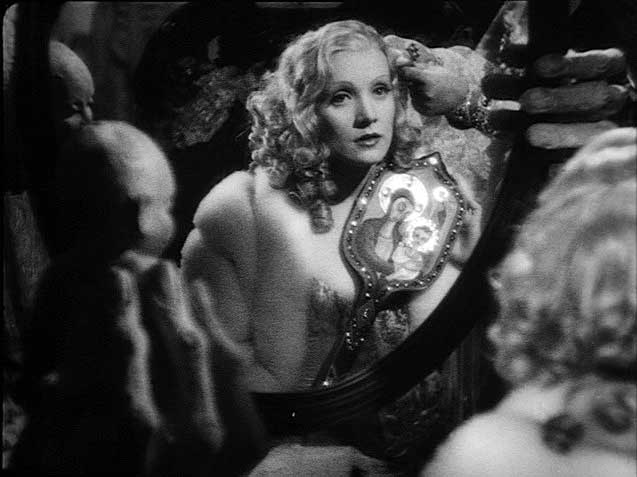
The Scarlet Empress

Living a quiet life in the German countryside, a young princess (Marlene Dietrich) becomes betrothed to Peter, Duke and heir apparent to the Russian throne. After making the arduous trek to St. Petersburg, she finds her husband (Sam Jaffe) to be an impotent, moronic sadist and her life taken over by a domineering mother-in-law (Louise Dressler). Taking solace in the arms of a rogue officer (John Lodge), she learns the ropes of the courts, and gradually transforms herself into a powerful, calculating Catherine the Great. The Scarlet Empress was the sixth of seven films in a short term though highly prolific collaboration between Josef von Sternberg and Dietrich. Made at the time of the newly adopted Hayes Code, this grand spectacle is somehow still incredibly suggestive (and blatantly carnal at other times), made with a sly sense of humor, and dominated by amazing set pieces, dizzying camerawork, and unrelenting editing. Dietrich runs an impressive gamut, going from naive pawn to manipulative seductress.
**** out of ****

Saturday, June 25, 2016

The Thin Man/After the Thin Man

Retired private eye Nick Charles (William Powell) and lively wife/assistant Nora (Myrna Loy) drink and kid in the presences of their terrier Asta while taking on the case of a friend's disappearance, almost for a lark. The sequel involves another missing person's case, this time Nora's cousin's ne'er do well husband, and a greater extortion plot involving the cousin's lover, a wealthy club owner (Jimmy Stewart). The Thin Man delighted Depression era audiences sorely in need of a lift with its playful, funny approach and the unmatched chemistry between Powell and Loy almost incredibly taking precedence to the entangled, secondary Dashiell Hammett murder plot. After the Thin Man (the sophomore effort in a series that spawned five sequels, a TV show, and a remake that has been in development for several years) follows its predecessor almost to a tee, often lamely, Nick and Nora appear less, with a lot more of Asta, who had achieved celebrity status at the time, thrown in for good measure and still retaining the same sense of lightness and fun.
The Thin Man: *** 1/2 out of ****
After the Thin Man: *** out of ****

Friday, March 20, 2015

The Complete Works of Jean Vigo

Jean Vigo was a surrealist French director whose life was cut short by tuberculosis at 29, but whose limited body of work (consisting of only four films, one of which was feature length) not only provided a window of what could have been and served as a major influence for the future of world cinema, but stands quite sturdily, in their own offbeat and lightly poetic way. His debut film was A Propos de Nice, a fascinating documentary covering all walks of life in Nice and was probably inspired by the landmark Man with a Movie Camera. It was followed by Taris, a brilliant and innovative instructional film featuring the eponymous swim champion, which was succeeded by Zero for Conduct, a whimsical tale detailing a boarding school rebellion. L'Atalante, his final and most cited and cherished work, tells a breezy and aimless story about newlyweds travelling upriver with a gruff riverboat captain, and features amusing situations, likable performances, and some great cinematography.

Wednesday, April 4, 2012

Tarzan the Ape Man/Tarzan and His Mate

"Tarzan the Ape Man" and "Tarzan and His Mate" were the first two adaptations of the Edgar Rice Burroughs novels featuring Johnny Weissmuller and Maureen O'Sullivan in their iconic roles and are generally considered by fans to be the best. Both are extremely similar, begin with white imperialists seeking a mythic Elephant burial ground in the deepest parts of Africa, and mesh imagery with the documentary "Trader Horn". On the first film's quest they find Tarzan, a man raised in the wilds of nature who fascinates Jane, the daughter of one of the members of the safari members. After Tarzan saves the day, Jane decides to leave civilization to live with him in the jungle. The second film follows basically the same story, Jane's beau on the same mission now trying to rescue her from the wild. These two Tarzan entries are well-made and surprisingly thrilling (I actually gasped during a sequence where Jane falls off a mountain pass), but are most notable for their pre-code sexually scintillating manner of dress (or lack thereof). A skinny dipping segment in the second film almost must be seen to be believed it was made by a major studio in 1934. Much of these films are silly, but achieve their goals in providing thrilling and candid entertainment.

Tuesday, April 3, 2012

Treasure Island

A drunken pirate stumbles into a pub overseen by young Jim Hawkins and his mother. Soon the old pirate is murdered and among his belongings, Jim finds an old treasure map. Soon Jim has booked a ship and hired a crew, among which is the treasonous scurvy dog Long John Silver and his men who have signed on the galley and plan to overtake the ship and keep the gold for themselves. Now the impressionable Jim's loyalty is torn between his own men and that of the charismatic but amoral Captain Silver. Robert Louis Stevenson's classic children's tale receives an excellent treatment in this early MGM production helmed by Victor Fleming. Having read "Treasure Island" as a child, I had forgotten (or maybe didn't realize) how brutal and calculated the actions of Long John Silver are. As the lovable tyrant, Wallace Beery is ideal, fully capturing the particulars of his complex character. As Jim, Jackie Cooper is often criticized for his performance, but I thought he wonderfully embodied a wide-eyed and confused young boy (the last bit of deceit between him and Beery is a doozy). Classic supporters round out the cast including Lionel Barrymore and Nigel Bruce. "Treasure Island" is a fine adaptation that captures the adventurous and often wicked spirit of the novel.

Strikes and Spares

"Strikes and Spares" is an Oscar nominated short from 1934 that features top professional bowler Andy Varipapa demonstrating proper bowling technique followed by an incredible trick shot display. Filmed showing two lanes with a manual pin setter, this film is pretty fascinating not only for the impressive bowling ability of its star but also for the nifty camerawork employed by the filmmakers. You can watch the short in its entirety below:

Saturday, January 21, 2012

The Lost Patrol

During the Mesopotamian campaign during World War I, a desert regiment's commanding officer has been shot. Having not relayed or recorded his recent orders, the troop knows not where they are to rendezvous. So now led by a brave sergeant, the troop decides to rest at an abandon fort where they await reinforcements and battle the menacing and relentless Arabs who strike in the blinding desert night. "The Lost Patrol" is a high concept and highly entertaining suspense film from legendary director John Ford. Based on Philip MacDonald's book Patrol, Ford's film employs an "And Then There Were None" which is carried out with much suspense to great effect. Ford stalwart Victor McLaglen provides a commanding performance as does much of the supporting cast, most notably being Boris Karloff as a religious zealot who quickly loses his mind. "The Lost Patrol" is an early success for John Ford who would continually revisit similar themes of courage and cowardice in his many subsequent masterpieces.

Monday, November 21, 2011

Twentieth Century

Oscar Jaffe is a Broadway producer with a penchant for the dramatic and egotism so steeped that his name appears on the billboard for his new play no less than five times. When the director wants to can the hayseed he has personally chosen to star in his production, Jaffe takes the reins and transforms her into a huge success. After a string of hits though his jealousy gets the best of him and she leaves for Hollywood, leaving him with a string of bad luck though. Fortuitously, the two end up together on a New York bound train from Chicago and the maniacal director will do anything in his power to get her back. "Twentieth Century" is one of the earliest screwball comedies and one of the best. Versatile director Howard Hawks' film, written by Ben Hecht and Charles MacArthur from their stage play, is a madcap romp, replete with many belly laughs, thanks to the performances of John Barrymore and Carol Lombard. In a performance that surely inspired Mel Brooks' Max Bialystock in "The Producers", Barrymore gives a wickedly funny performance as the delusional and self-aggrandizing Jaffe. Lombard is just as adept as well, and their onscreen chemistry is marvelous. Hawks' was a maverick director who crossed genres as well as any other colleague. In his early career, his screwball comedies including this, "Bringing Up Baby", and "His Girl Friday" set the standard for madcap movies and remain some of the most riotous ever filmed.

Wednesday, June 16, 2010

Cleopatra

When Cecil B. Demille's Cleopatra from 1934 came up on my list, I shuddered a little bit as I was wary that I'd be getting a stilted and dated historical retread. Instead, I was more then pleasantly surprised to realize that this film was as alive and full-blooded as most of the historical epics that I'd seen. This story tells Cleopatra's exile from Egypt, her romances with Julius Caesar and Marc Antony, and when war was declared on her by Rome. Claudette Colbert makes an excellent and seductive Cleopatra and the sets, costumes and battle scenes are extremely well done, which should be no surprise since DeMille was at the helm.
***1/2