Showing posts with label 1970. Show all posts

Sunday, December 24, 2017

Scrooge

Perennial Charles Dickens Christmas classic received a musical makeover in this 1970 Ronald Neame version that tries to recapture the magic of Oliver! even though the material doesn’t really call for it or need it. Further, the music is mostly forgettable except for the “Thank You Very Much” number which memorably features a tap dance on Scrooge’s coffin and a rollicking funeral parade. Albert Finney plays a surprisingly shrill and somewhat disappointing Scrooge and Alec Guinness is also a letdown as a droll Jacob Marley.
** ½ out of ****

Thursday, February 16, 2017

El Topo

A man in black (Alejandro Jodorowsky) travels on horseback with his unclothed son across a decadent, psychadelic Western desert landscape encountering all sorts of variant, distorted people and places. Jodorowsky's El Topo is wildly bizarre, pointless, and surprisingly not all that fun for what is one of the original midnight movie phenomenons.
** out of ****

Thursday, September 15, 2016

Flying Circus and the Python Films

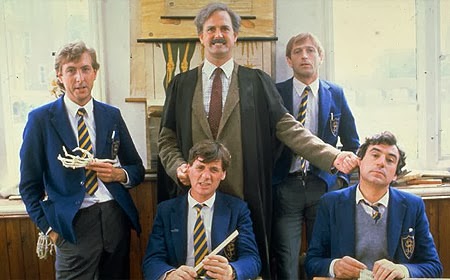
It is difficult to describe the appeal of Monty Python, the irreverent and game changing British comedic troupe, when their irreverent material is as often inane and borderline unwatchable as it is uproarious. Nevertheless the appeal of the group, which consists of members John Cleese, Graham Chapman, Michael Palin, Terry Jones, Eric Idle, and Terry Gilliam and began on the stage and continued on through television and film, is undeniable and their influence on comedy is immeasurable. Here is a brief rundown of their work:

Flying Circus ran on the BBC between 1969 and 1974 with a feature film titled with the group's favorite segue And Now for Something Completely Different sandwiched midway in its run which took the odd approach of refilming some of their greatest hits without of the presence of a studio audience, the result of which is strangely compelling. The series has many regrettable sketches and running gags, and I feel I should keep my opinion on Gilliam's animations to myself in fear of being shunned, but it is absolutely worth suffering the dreck to get to their best and most outrageous routines (or you could just watch them on YouTube---my favorite bit is Palin's bumbling Spanish Inquisitor).

The gang followed up the series with Monty Python and the Holy Grail, perhaps the most widely seen of their features and what I'd personally consider the best of the lot. This silly take on the Arthurian legend has many indelibly hysterical moments and only starts to come apart at the seams towards the very end.

The controversy generated by Life of Brian, which tells the tale of the child born a manger over from Christ, catapulted the Pythons to international superstardom, but the film offers easy and obvious satire, with belabored gags, and laughs that are few and far between (though those few present are hearty). Gilliam's direction does achieve great period look (though his influence beyond that is distracting) and Palin's Pontius Pilate is unforgettable. Casting Chapman in the lead serves as a great disappointment considering what is lost in the supporting roles.

Time Bandits is not officially a Python movie but it was directed by Gilliam who cowrote the script with Palin and features cameos from both Palin and Cleese. The fantastical and occasionally creepy children's story deals with a band of dwarves in possession of a time travel map who take a neglected youth on their marauding journey through history. The film again falls apart towards the end but the actors are likable and the proceedings are worthwhile for the hilarious cameos, which also include Ralph Richardson and Sean Connery. 

Next up was Live at the Hollywood Bowl, a live show converted to film and released theatrically which consists of old sketches and new that comes off quite well leaving you pondering if their material isn't best suited for the stage. 

Meaning of Life, which takes a surreal look into each of life's stages, is a sporadically funny feature which is hurt by dark and atypically heavy dosages of cynicism and vulgarity. The short film that opens the movie is a highlight and the "Every Sperm is Sacred" number is priceless.

In 2014, the Pythons returned for a live farewell show of sorts, Monty Python Live (Mostly), which featured an array of live performances, clips old and new, and a musical revue, all with the participation of the remaining and surprisingly capable troupe members, save Graham Chapman who is roundly toasted during the performance.

Sunday, March 20, 2016

Le Boucher

Shortly after starting a new job in a rural French town, a schoolteacher is romanced by the local butcher who raises her suspicions when a series of gruesome murders strike the insular community. Claude Chabrol's 1970 psychological thriller and Hitchcokian homage (which goes without saying for a New Waver) is suspenseful and involving, told and filmed in an offbeat manner with an ominous cloud hanging over entire picture.
*** 1/2 out of ****

Friday, December 4, 2015

Even Dwarfs Started Small

A group of mentally disturbed halflings take control of their rural institution, detaining the headmaster while performing a series of abnormal and destructive rituals. Even Dwarfs Started Small, an early entry from Werner Herzog, is an incredble blend of bizarre imagery and visionary staging, which also is virtually plotless, existing almost solely as weirdness for weirdness' sake.
*** out of ****

Monday, September 7, 2015

Eric Rohmer's Six Moral Tales

When the New Wave landed on shores of France and rocked world cinema, Eric Rohmer quietly but intently observed the work of his contemporaries from the Cahiers du Cinema offices where he worked as an editor. There he plotted a series of ostensibly related films, all dealing with a middle class protagonist's responding to a temptress, which were filmed over the period of a decade, and were grouped together as the Six Moral Tales.

The Bakery Girl of Monceau (1963) is a short two reeler, simple, offbeat, talky, icy, and beautifully shot, effectively setting the tone for the entire series. Featuring future directors Barbet Schroeder in the lead and Bernard Taverneier as narrator, it tells the story of a young attorney who makes increasingly frequent visits to a neighborhood confectionery to encounter the title clerk.
*** 1/2 out of ****
Suzanne's Career (1963) followed, and is an intelligent and incredibly prescient, here detailing a woman coming in between the friendship of two friends, one a skirt chaser the other a bashful introvert.
*** 1/2 out of ****
La Collectionneuse (1967) was the first feature film realeased in the series but was actually intended as the fourth tale, bumped up on the shooting schedule when Rohmer failed to achieve weather effects and postponed My Night with Maud. It tells an idyllically set and beautifully shot story of cruel intellectualism about two friends vacationing on the Riveria who find their vacation impeded by a promiscuous guest. 
*** 1/2 out of ****
My Night with Maud (1969) may be the best known of the lot and is my candidate for the finest realization in an unrivaled program. An uptight intellectual bumps into an old friend around the holidays, is invited for dinner to a recently divorced knock-out's chateu, where the two wind up alone, discussing love and philosophy before getting down to business. Perceptive, crisply filmed, and wonderfully acted
*** 1/2 out of ****
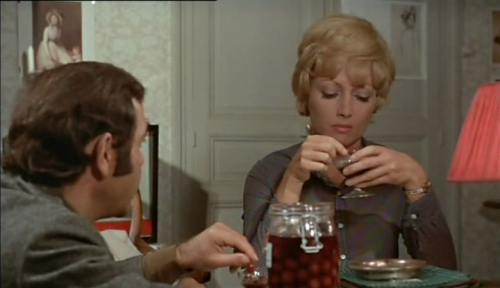
Claire's Knee (1970) involves a diplomat on vacation and awaiting marriage who, while visiting with an ex-lover, becomes obsessed with the idea of caressing his landlady's stepdaughter's knee. 
This fifth entry is somewhat creepy, but again retains the film values of its predecessors and remains very watchable
*** 1/2 out ****
Chloe in the Afternoon (1972) concluded the series and, true to form, is involving, low key, and dialogue heavy. Its plot revolves around a happily married Parisian lawyer who hopelessly pursues a bohemian seductress.
*** 1/2 out of ****

Saturday, July 4, 2015

Patton/The Last Days of Patton

Patton
Sent to command the undisciplined and outmatched American outfit in 1943 North Africa, General George Patton leads his troops to victory over Rommel and on into Italy where his great success was challenged by his own ego, stubbornness, and pride. George C. Scott towers over Franklin J. Schaffner's epic WWII biopic in a commanding, larger than life, and even sensitive performance, one of the greatest ever committed to celluloid. Francis Ford Coppola's Oscar winning screenplay is intelligent, humorous, and highly watchable, and Karl Malden contributes excellent support as General Omar Bradley. 
**** out of ****

The Last Days of Patton
Sixteen years following the release of Patton, Scott returned to the role for the made for TV movie which details the great General's difficulties in overseeing the reconstruction of postwar Bavaria, his relegation to a toothless, bureaucratic position, and his impending death following a road accident. The Last Days of Patton marks a continuation of Scott's iconic, still remarkable performance in a mildly engaging, overlong movie which suffers from flashback structure which details Patton's years as a young soldier.
*** out of ****

Friday, July 3, 2015

The Garden of the Finzi-Continis

A group of Italian semitic and gentile friends gather at the illustrious, Jewish Finzi-Contini estate in the late 1930s playing tennis, romancing, and basking into their idyllic paradise, totally oblivious to the impending fascist threat bearing down upon them. Vittorio de Sico's The Garden of Finzi-Continis, from a novel by Giorgio Bassani, is a beautifully photographed take on an uninvolving and oddly retracted story.
*** out of ****

Monday, March 24, 2014

The Conformist

Set during the reign of Italian Fascism, through a time shifting flashback structure we learn how a spineless middle class citizen joined the secret police and attempted to seduce his radical teacher's wife while struggling with his own sexuality before conscripting to have his one time mentor assassinated. From a novel by Alberto Moravia, Bernardo Bertolucci's The Conformist is a dense and challenging film, spotlighted by great photography, an incredible ending, and a complex lead performance from Jean-Louis Trintignant.

Sunday, March 16, 2014

MASH

Whether confronting an uptight colleague (Robert Duvall) or harassing the high-strung Hot Lips (Sally Kellerman), Army Captains Hawkeye (Donald Sutherland) and Duke (Tom Skerritt) run their Korean based surgical unit with a sort of anarchic, reckless abandon while still maintaining competence in their work. They are only reinforced when like minded Trapper (Elliot Gould) is reassigned to their division who gleefully partakes in the hijinks. From a screenplay from Ring Lardner Jr., who worked from a novel by Richard Hooker, Robert Altman's precursor to the long running TV series is a funny, way offbeat comedy that nails its satiric barbs, features an engaging performance from Sutherland, and a riotous, madcap conclusion.

Monday, March 10, 2014

The Adventures of Antoine Doinel

In 1959 Francois Truffaut, along with other members of the French New Wave, shook the world when he introduced the character of Antoine Doinel, a class clown quickly graduating to juvenile delinquency with disinterested parents and an affection for Balzac, in his masterful and intensely personal The 400 Blows. Played by Jean-Pierre Leaud, whose earnestness won over his director during the casting process, would return to the character with Truffaut five times over the course of twenty years in a series of films that turned away almost entirely from the inward emotiveness of the debut to a more lightly comic but still mostly masterful touch. 
As part of the 1962 anthology Love at TwentyAntoine and Colette was the first followup and shows Antoine surprisingly on his own as a young man and attempting to woo a young woman whose feelings aren't exactly reciprocated. The film is observant and an excellent example of short form storytelling.
After a six year hiatus, Truffaut and Leaud returned to Doinel with Stolen Kisses, a light, disarming, and insightful picture showing their hero discharged from the military, job hopping, and taking up with an ex-girlfriend.
1970 saw the release of Bed & Board which was a little more dense and mostly focused on the story's comic highs. Here, Doinel finds himself married with a child on the way but still manages to entangled himself in an affair with a Japanese client.
Love on the Run concluded the series five years before Truffaut's death in 1984, although he claimed it was the final installment. Its story shows Antoine's marriage still intact although he continues to seek extramarital company elsewhere. The film imposes a flashback structure composed of clips from the other films which doesn't really work, but the new material is presented in the same vein as the others and is generally entertaining.

Wednesday, September 11, 2013

Woodstock

The Woodstock Music Festival, the "3 Days of Peace and Love" celebration at Max Yasgur's farm in Bethel, New York, was not just an ultimate sendoff to the 1960s but also an instance of mass harmonious cooperation that was nothing short of remarkable. In his landmark documentary, director Michael Wadleigh employed a squadron of cameraman (which included Martin Scorsese, who was eventually booted from the project but received billing as an editor) and cut his film from miles and miles of footage into a documentary that often features several split screens and viewpoints. Not only does the film cover the spirited performances (Richie Havens, Sly and the Family Stone, and Hendrix's finale are highlights), but also captures the various facets of the festival, such as interviews with the unenviable sanitation workers or the sweet-natured locals who, for the most part, didn't mind lending their backyards to the half a million festival goers for the time of their lives they would never remember. That is had it not been for the movie.

Friday, September 6, 2013

The Twelve Chairs

On her deathbed, an old Russian woman reveals to both her son-in-law (Ron Moody) and her priest (Dom DeLuise) that she has sewn a small fortune of jewels into the seat of one chair of a twelve piece set which, as luck would have it, has been dispersed across a vast expanse of the empire. Working against the priest, the son-in-law, a hapless nobleman, is joined by a shifty con artist (Frank Langella) on his wild goose chase. The Twelve Chairs is an often humorous and occasionally meandering early film from Mel Brooks who adapted, of all things, a 1928 Russian novel. The film features hilarious performances from DeLuise and especially Moody.

Wednesday, April 24, 2013

Beyond the Valley of the Dolls

Following the success of "Valley of the Dolls", 20th Century Fox secured the naming rights to a sequel and hired successful sexploitation pioneer Russ Meyer to direct, who in turn hired Roger Ebert, a young Chicago critic who had defended his work, to write the screenplay. Deciding to go in the different direction of madcap horror and satire, Meyer and Ebert worked at a frenetic pace and completed the screenplay in about six weeks, which tells the story of a female rock band who set out for fame and fortune in L.A. but fall prey to the sex and drug crazed depravity of the time. Following Roger Ebert's passing earlier this month, I decided to finally check out "Beyond the Valley of the Dolls", although I did not technically watch the film, opting to play it with Ebert's commentary track instead. This mode of viewing was engaging and informative, as Ebert describes the genesis of the film, speaks to the times and importance of the movie (which he may slightly oversell), and largely speaks of Meyer, who became a lifelong friend. There are many interesting tidbits to be found here which include how Meyer would boarded up windows on the living quarters of his films so the actors would save up their sexual energy for the camera or how a bizarre real life incident with footballer Jim Brown worked its way into the screenplay. Ebert also relays fantastic WWII stories Meyer would tell (including a failed attempt to capture Hitler with General Patton) and recalls how they were later hired to pen an ultimately unfilmed Sex Pistols movie and how Meyer berated a slightly taken aback Johnny Rotten during a meeting. "Beyond the Valley of the Dolls" is not a film I would typically seek out and probably would have viewed with cynicism. But like many films which he reviewed throughout his illustrious career, Roger has helped provide insight and appreciation I may not have found on my own.

Wednesday, December 5, 2012

Gimme Shelter

A radio DJ informs us there were four births and four deaths at the Altamont Speedway in San Francisco, the last of which was an alleged stabbing under investigation, during the closing concert of the Rolling Stones 1969 tour. We then see Mick Jagger, Keith Richards, Charlie Watts, and Ronnie Wood speechlessly regarding the footage of a Hell's Angels member, hired to do security, mortally attacking an unruly fan. The film then doubles back showing the band in New York booking the gig, setting up for the massive show (and making incredibly shortsighted decisions in the process), and performing in what many see as a nightmarish symbol to the end of the tumultuous 60s and the death of the pathetic counterculture. Brothers Albert and David Maysles' rock doc "Gimme Shelter" is a vivid, uncanny, and terrifying record which was the result of bad decisions, bad drugs, and a general air of bad feelings, all of which is captured along with powerful Stones' performances from throughout the tour.

Saturday, November 24, 2012

Catch-22

During WWII on the island of Pianosa located in the Mediterranean, Capt. Yossarian (Alan Arkin) finds his discharge request on the basis of insanity denied on the illogical Army maxim that a person recognizing his own insanity cannot in fact be declared. Yossarian now bears witness witness to the mad of war that envelops him as he deals with self serving superiors, the prospect of flying interminable missions, and witnessing the death of his contemporaries. "Catch-22" is a surprisingly sturdy adaptation of Joseph Heller's monumental 1962 which is probably unfilmable but must have seemed prime for a generation engulfed in the Vietnam War. It was director Mike Nichols and writer Buck Henry's (who also appears in the film as Lt.Col. Korn) followup to "The Graduate",  and they make tolerable changes and offer about as good of an adaptation as can be expected, although much of Heller's dialogue is sadly omitted. I found Arkin to be wrong for Yossarian, as he contains hardly any of the disbelief or exasperation which distinguished that character as a hallmark of American literature. The greatest strength of the film can be found in the casting of the supporting roles of the eccentric servicemen, with Orson Welles, Martin Balsam, and Bob Newhart standing out as the most memorable.

Saturday, August 11, 2012

The Up Series

Tony, a participant in "The Up Series", at various stages of his life
In 1964, a British documentary crew interviewed a group of seven year olds from various economic backgrounds and asked them about their hopes, fears, and lives in general. Every seven years since then, Michael Apted, a member of the original crew, has revisited each of these participants to catch up with them and discuss their lives. "The Up Series", as these programs have come to be collectively known, are an endlessly fascinating form of time lapse filmmaking, as we see each of the film's subjects age before our eyes, as Apted interweaves prior footage into each new film. Keeping things simple, each film is simply a sit down with each person and a catch up on their lives, as they discuss with candid honesty the turns their lives have taken. Apted resists the urge to jazz things up and is straightforward presentation only adds, rather then detracts, to overall impact of these powerful films. The stories that I enjoyed the most include Tony, a young boy who dreams of being a jockey and grows up to be a cab driver, still full of zeal; Suzy, an unhappy young woman who finds solace and happiness with her husband and children; Bruce, a boy with missionary aspiration who winds up teaching in the inner city; John, a boorish snob who remains a boorish snob but becomes involves in relief work in Eastern Europe; and then their is Neil, discontented young man who drops out of school and becomes a vagrant who well, I don't want to spoil that one. "The Up Series" is about as real and engaging a film can get and I eagerly await the next installment, due out soon, as these subjects approach the twilight of their lives.
Here is a very brief description of each installment:
Seven Up! (1964)
A collection of British seven year olds, both female and male, from different socioeconomic backgrounds are introduced and interviewed as they talk about subjects such as school, money, race, and their futures. After meeting them all individually, the children all attend a party and we see how they interact.
7 Plus Seven (1970)
We revisit the subjects at age 14, midway between childhood and adulthood.
21 (1977)
Now 21 years old, the group of people we met at 7 and 14 now have clearer ideas on life and what they want their lives to be.
28 Up (1985)
Maybe its because I am now of the same age as the subjects here, but it is this installment that the series begins to take on resonance, as its subjects have largely settled down with family and careers.
35 Up (1991)
As the subjects move closer towards middle age most are firmly rooted in their lives with a few exceptions as they begin to deal with divorce and death of their parents, and other issues while the most fascinating member of the group continues to fascinate us.
42 Up (1998)
As the subjects have now reached the midpoint of their lives, most are firmly rooted with the exception of a few extraordinary examples, one involving an incredible intersection of two of the subject's lives.
49 Up (2005)
As the hairs have grayed, the hairlines receded, and the waistlines expanded, the subjects approach 50 mostly with contentment as they embrace grandchildren, their partners, careers, and life turns.
56 Up (2012)
The participants return, mostly contented with their lots as they face retirement and brace themselves for old age.

Thursday, April 26, 2012

Love Story

A brooding Harvard student of means wanders to nearby Radcliffe College and check out a book from their library and falls for the imperfect, blue-collared girl behind the counter. To the chagrin of his disapproving father, the two begin a courtship and we follow them through the peaks and valleys of their loving and ultimately tragic union. "Love Story" is ubiquitous, shameless, and often insincere pap that is not entirely without appeal. Ryan O'Neal and Ali MacGraw bring a great likability to their characters, and are aided greatly by the supporting actors playing their fathers, Ray Milland his and John Marley as hers. Arthur Hiller's film is a contradictory one, a movie with off-putting qualities that is somehow made palatable and enjoyable, mostly due to the fact of the allure of its cast.

Monday, September 19, 2011

Husbands

Feeling their mortality after burying their pal, three middle aged man go on a bender that begins in their hometown New York and ends across the ocean in London as they drink, mourn, exercise, philander, and reevaluate their lives. "Husbands" was John Cassavetes followup to his acclaimed "Faces" and it is, like his other films, a plot thin reflective film that deals with human interactions and emotions. Its stars, Ben Gazzara, Peter Falk, and Cassavetes himself are incredibly strong in their roles and their characters are fleshed out particularly well. However, powerful moments get stretched out and lost in repetitively long sequences. Still, Cassavetes was a director who never followed a rubric, and I appreciate his films because they give you an opportunity to think and reflect. By not rushing and employing a traditional plot and focusing on character, they take on a richer quality. Still, I will not say they are easy going and especially here with "Husbands", again with the incredibly long sequences, it can be hard to sit still.

The Wild Child

In a French forest in 1798 hunters are dispatched to kill a wild animal which turns out to be a young boy raised in the wilderness who has no means of manner or verbal communication. Sent to the Institute of the Deaf and Dumb, a doctor takes the boy to his home, feeling the clinic's methods will not aid the boy. With the help of his maid, the doctor begins the painstaking stance of not only teaching the boy manners and how to talk, but also of instituting a moral sense within him. "The Wild Child" is an astonishing tale by director Francois Truffaut which is essentially an affecting story of love and determination. Truffaut himself plays the doctor, Jean-Pierre Cargol plays the wild boy, and Francoise Seigner plays the maid and all are terrific at playing determined individuals dealing with their extremely frustrating tasks at hand. The film is shot in beautifully delicate black and white and I admired Truffaut's bravery in showing the realities and the pains of a situation like this. I could see how there could be an urge to turn this into a padded success story full of triumphs, but the triumphs here are small and Truffaut wisely focuses on the determination, doubts, and affections of all three members of the group. "The Wild Child" is a fascinating film that is incredibly affecting without cutting corners.