Showing posts with label 1972. Show all posts

Wednesday, January 11, 2017

Fat City

An aging, drunk boxer (Stacey Keach) living in a Southern Californian slum and romancing a taken, volatile lush (Susan Tyrrell) becomes inspired to get back into fighting condition after sparing with a young, green pugilist (Jeff Bridges) headed down his same path. With great performances leading the way, John Huston's Fat City begins with boxing movie cliches and takes a deeper look while also sensibly commenting on poverty, race, and exploitation in sports.
*** 1/2 out of ****

Wednesday, October 26, 2016

The Last House on the Left

Two teenage girls leave their rural home for a night in the city. After attending a concert, they try to score drugs but wind up in the hands of a couple of sadistic fugitives who take them on a joy ride, torturing, raping, and murdering them before winding up as guests at one of the victim's home, setting the table for an appropriately savage revenge. Wes Craven's The Last House on the Left, a remake of Ingmar Bergman's The Virgin Spring of all movies, is exploitative trash that has begotten landfills of similar muck. However with its dippy psychedelic aura, an incongruous comedic subplot, and farcical ending, the movie achieves a camp value you wouldn't expect, even if it doesn't ultimately resemble a horror flick.
** 1/2 out of ****

Thursday, September 15, 2016

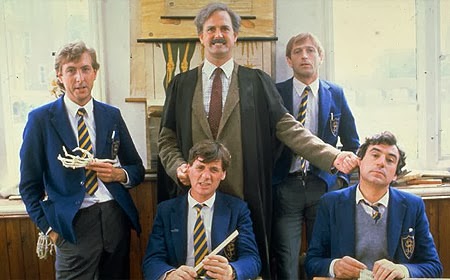
Flying Circus and the Python Films

It is difficult to describe the appeal of Monty Python, the irreverent and game changing British comedic troupe, when their irreverent material is as often inane and borderline unwatchable as it is uproarious. Nevertheless the appeal of the group, which consists of members John Cleese, Graham Chapman, Michael Palin, Terry Jones, Eric Idle, and Terry Gilliam and began on the stage and continued on through television and film, is undeniable and their influence on comedy is immeasurable. Here is a brief rundown of their work:

Flying Circus ran on the BBC between 1969 and 1974 with a feature film titled with the group's favorite segue And Now for Something Completely Different sandwiched midway in its run which took the odd approach of refilming some of their greatest hits without of the presence of a studio audience, the result of which is strangely compelling. The series has many regrettable sketches and running gags, and I feel I should keep my opinion on Gilliam's animations to myself in fear of being shunned, but it is absolutely worth suffering the dreck to get to their best and most outrageous routines (or you could just watch them on YouTube---my favorite bit is Palin's bumbling Spanish Inquisitor).

The gang followed up the series with Monty Python and the Holy Grail, perhaps the most widely seen of their features and what I'd personally consider the best of the lot. This silly take on the Arthurian legend has many indelibly hysterical moments and only starts to come apart at the seams towards the very end.

The controversy generated by Life of Brian, which tells the tale of the child born a manger over from Christ, catapulted the Pythons to international superstardom, but the film offers easy and obvious satire, with belabored gags, and laughs that are few and far between (though those few present are hearty). Gilliam's direction does achieve great period look (though his influence beyond that is distracting) and Palin's Pontius Pilate is unforgettable. Casting Chapman in the lead serves as a great disappointment considering what is lost in the supporting roles.

Time Bandits is not officially a Python movie but it was directed by Gilliam who cowrote the script with Palin and features cameos from both Palin and Cleese. The fantastical and occasionally creepy children's story deals with a band of dwarves in possession of a time travel map who take a neglected youth on their marauding journey through history. The film again falls apart towards the end but the actors are likable and the proceedings are worthwhile for the hilarious cameos, which also include Ralph Richardson and Sean Connery. 

Next up was Live at the Hollywood Bowl, a live show converted to film and released theatrically which consists of old sketches and new that comes off quite well leaving you pondering if their material isn't best suited for the stage. 

Meaning of Life, which takes a surreal look into each of life's stages, is a sporadically funny feature which is hurt by dark and atypically heavy dosages of cynicism and vulgarity. The short film that opens the movie is a highlight and the "Every Sperm is Sacred" number is priceless.

In 2014, the Pythons returned for a live farewell show of sorts, Monty Python Live (Mostly), which featured an array of live performances, clips old and new, and a musical revue, all with the participation of the remaining and surprisingly capable troupe members, save Graham Chapman who is roundly toasted during the performance.

Wednesday, July 20, 2016

Jeremiah Johnson

A Mexican-American War veteran (Robert Redford) drops out of society and heads for the Rocky Mountains where he takes tutelage from a proven fur trapper (Will Geer) and soon finds himself living happily off the land with an Indian wife and adoptive son. When the U.S. Cavalry officer persuades him to lead an expedition over sacred burial ground, the Crow people retaliate by slaying his newfound family, leading to a one man showdown between the tribal nation and the fabled frontiersman. Drawn from the true to life story of John Johnson by Raymond W. Thorp in his novella Crow Killer, Sydney Pollack's meditative mountain man saga lacks a sense of urgency although there is something appealing about a contemplative modern western. This somber mood of the film also makes the sudden, unexpected, and well edited bursts of violence all the more effective. Impeccable Utah locations and flavorful supporting characters are a major asset, and with regards to Redford's performance, it is remarkable that throughout his career he was continually able to make these one dimensional, quietly masculine good guy personas so compelling.
*** out of ****

Monday, June 6, 2016

Last Tango in Paris

While apartment hunting, a middle aged American expat (Marlon Brando) overcome by his wife's suicide meets a young Parisian girl (Maria Schneider) engaged to a witless dolt (Jean-Pierre Leaud), and the two agree to meet again and make a fleeting arrangement based on anonymous, demeaning, and ultimately revealing sex. Bertolucci's controversial and regarded Last Tango in Paris is on one hand an exercise in pretentiousness and crudity while on another a masterfully filmed, complex character study containing what may be the finest, most personal performance of Brando's career.
*** 1/2 out of ****

Wednesday, April 13, 2016

The Bitter Tears of Petra von Kant

A fashion designer (Margit Carstensen) mistreats her mute secretary (Irm Hermann) and becomes jealousy obsessive over one of her models (Hanna Schygulla), whom she left her husband for. Reworked from his autobiographical all male chamber drama to an all female casted film, Rainer Werner Fassbinder's The Bitter Tears of Petra von Kant is methodically paced, and hard to get into at first but completely after a certain point. The set decor and photography are top of the line and Carstensen's peformance is tragic and memorable.
*** 1/2 out of ****

Wednesday, March 23, 2016

Solaris (1972 and 2002)

A psychologist is sent to investigate disturbances involving members of the crew at a space station and, upon arrival, is quickly haunted by visions of his recently deceased wife. Andrei Tarkovski's Solaris, an adaptation of Stanislaw Lem's novel is extremely protracted (as expected) and yes overlong, though introspective, beautiful, and stirring with great performances especially by Nataly Bondarchuk. Steven Soderbergh's remake 30 years on has none of the original's patience nor hypnotic qualities, although George Clooney inhabits the lead role strongly and stoicly, and Viola Davis is confident in support.

1972 version: *** 1/2 out of ****
2002 version: ** 1/2 out of ****

Saturday, February 13, 2016

Everything You Always Wanted to Know About Sex* (*But Were Afraid to Ask)

Inspired by the bestselling self-help manual, Everything You Always Wanted to Know About Sex* (*But Were Afraid to Ask) are seven irreverent shorts from Woody Allen, some of which are laugh out loud funny, others not (most the ones that feature Woody), and some are just out there. The best segments involve John Carradine as a mad sex researcher, Lou Jacobi as a middle aged cross dresser, Gene Wilder as a doctor who loses everything after falling in love with a sheep, and the now famous imagining of the inner workings of the male body during intercourse.
*** out of ****

Friday, November 27, 2015

Cries & Whispers

A woman lays dying of cancer in a remote country estate (Harriet Andersson) and receives no comfort from her emotionally cold, self-serving sisters (Liv Ullmann and Ingrid Thulin), and gains her only solace from a saintly and mistreated servant (Kari Sylwan). Ingmar Bergman's Cries and Whispers astonishingly and in a quietly moving manner finds hope and affirmation in a harsh, castigating, and utterly bleak story. The film is brilliantly shot in profuse reds and whites and expertly acted by a band of Bergman familiars.
*** 1/2 out of ****

Monday, September 7, 2015

Eric Rohmer's Six Moral Tales

When the New Wave landed on shores of France and rocked world cinema, Eric Rohmer quietly but intently observed the work of his contemporaries from the Cahiers du Cinema offices where he worked as an editor. There he plotted a series of ostensibly related films, all dealing with a middle class protagonist's responding to a temptress, which were filmed over the period of a decade, and were grouped together as the Six Moral Tales.

The Bakery Girl of Monceau (1963) is a short two reeler, simple, offbeat, talky, icy, and beautifully shot, effectively setting the tone for the entire series. Featuring future directors Barbet Schroeder in the lead and Bernard Taverneier as narrator, it tells the story of a young attorney who makes increasingly frequent visits to a neighborhood confectionery to encounter the title clerk.
*** 1/2 out of ****
Suzanne's Career (1963) followed, and is an intelligent and incredibly prescient, here detailing a woman coming in between the friendship of two friends, one a skirt chaser the other a bashful introvert.
*** 1/2 out of ****
La Collectionneuse (1967) was the first feature film realeased in the series but was actually intended as the fourth tale, bumped up on the shooting schedule when Rohmer failed to achieve weather effects and postponed My Night with Maud. It tells an idyllically set and beautifully shot story of cruel intellectualism about two friends vacationing on the Riveria who find their vacation impeded by a promiscuous guest. 
*** 1/2 out of ****
My Night with Maud (1969) may be the best known of the lot and is my candidate for the finest realization in an unrivaled program. An uptight intellectual bumps into an old friend around the holidays, is invited for dinner to a recently divorced knock-out's chateu, where the two wind up alone, discussing love and philosophy before getting down to business. Perceptive, crisply filmed, and wonderfully acted
*** 1/2 out of ****
Claire's Knee (1970) involves a diplomat on vacation and awaiting marriage who, while visiting with an ex-lover, becomes obsessed with the idea of caressing his landlady's stepdaughter's knee. 
This fifth entry is somewhat creepy, but again retains the film values of its predecessors and remains very watchable
*** 1/2 out ****
Chloe in the Afternoon (1972) concluded the series and, true to form, is involving, low key, and dialogue heavy. Its plot revolves around a happily married Parisian lawyer who hopelessly pursues a bohemian seductress.
*** 1/2 out of ****

Thursday, July 16, 2015

Lady Sings the Blues

Abused as a child and relegated to life in a brothel, a young woman finds refuge and success as a nightclub singer while taking solace in alcohol and narcotics. Based on the life of Billie Holliday, Lady Sings the Blues doesn't avoid the cliches and pitfalls of its musical biopic genre but Ross is pure and powerful in an exceptional starring performance in addition to surprising turns from Billy Dee Williams and Richard Pryor.
*** out of ****

Wednesday, April 1, 2015

The Candidate

With no viable candidate to challenge the juggernaut Republican incumbent in the California Senatorial race, an affable, idealistic attorney (Robert Redford) and son of the former governor is tapped to run. Given the promise that he will have free reign over his campaign, he swears off his lifelong aversion to politics and enters the race. As the people respond to his direct manner and the gap closes, he faces incredible temptation to compromise his ideals. Michael Ritchie's The Candidate features Redford at his most starry-eyed, but for a populist film that sets out to be so satirically biting, it is all kind of humdrum and pedestrian.
** 1/2 out ****

Thursday, March 5, 2015

The Discreet Charm of the Bourgeoisie

Luis Bunuel's The Discreet Charm of the Bourgeoisie is a baffling and dreamlike film (with a plot that defies explanation) in which, like the equally inscrutable The Exterminating Angel, the act of dining figures prominently and proves problematic for a group of upper crusters. Despite its nature, the film never ceases to be involving (maybe partially due to its incomprehensibility) and features exquisite photography by Edmond Richmond.
*** out of ****

Sunday, November 16, 2014

The Ruling Class

Following the unfortunate role-playing related death of a prominent British Lord, his considerate estate is passed to his mentally disturbed progeny (Peter O'Toole) who thinks himself the second coming of Jesus Christ, all to the chagrin of his stodgy family who schemes to see his inheritance reappropriated. From Peter Barnes play, The Ruling Class is bizarre, outlandish fun to a point, boasting a virtuoso O'Toole performance, but is overlong, stagy, and even obnoxious as it eventually outstays its welcome.
** 1/2 out of ****

Monday, February 3, 2014

Frenzy

A serial rapist/strangler has been terrorizing the women of London and the manhunt focuses on a cagey, alcoholic, unemployed ex-airman (Jon Finch), a perfect candidate for the crime which he so inconveniently happens to be perfectly innocent of committing. For his penultimate film, Alfred Hitchcock returned to his mother country and his favorite plot line, that of the wrong man innocently accused, for a film that leaves little to the imagination but is no less masterful than any of his finest, widely known outings. Manipulating the audience with great facility, Frenzy is a compulsively watchable, darkly funny film featuring several memorable scenes (including an early one where you gradually realize along with a principle character that she will not be able to talk her way out of a jam and a later one where her corpse presents an original and maddening problem for the killer), an enjoyably gruff performance from Finch, and a virtuoso at the top of his game at the end of an unprecedented run.

Friday, July 26, 2013

Boxcar Bertha

A woman of the railcars (Barbara Hershey) and her labor organizing lover (David Carradine) dodge anti-Union forces in the Depression-era South and resort to armed robbery. Boxcar Bertha was a  Bonnie and Clyde knockoff produced by Roger Corman which also marked the sophomore outing for Martin Scorsese as a director. The production is important because it taught the great director economy and fundamentals about moviemaking, and the film itself is a modest B-picture, with an enjoyable, folksy first half giving way to an exploitative, violent, over the top finale. Hershey and Carradine prove very fine in their roles.

Saturday, June 15, 2013

The Godfather Trilogy

The saga of the Corleone crime family and their struggle to hold on from power and their fall from grace, as the sins of the father are passed on to his favorite son and the latter loses his soul. What more can be said about The Godfather films that hasn't already been said? Francis Ford Coppola's first two installments, made in collaboration with the source author Mario Puzo, are some of the finest examples of modern storytelling and moviemaking that we have. From the plot subtleties to the iconic performances (Marlon Brando, Al Pacino, James Caan, Robert Duvall, Robert De Niro) to Gordon Willis' breathtaking photography and Nino Rota's unforgettable score and even the somewhat unsung supporting performances (John Cazale, Richard Castellano, John Marley, Michael Gazzo, Lee Strasberg). Then there is the dreadful Part III, a film I was ready to defend, until realizing how poorly realized it is upon a recent viewing. Here Coppola does everything he seemed to be trying to avoid doing in the earlier films, and presents a horrible screenplay with godawful acting, which is abetted somewhat by good direction, yet is still a black eye on an otherwise exceptional and unsurpassable series.

Monday, January 21, 2013

Sounder

A family of sharecroppers in the backwoods of Depression-era Louisiana faces even more dire times when their proud patriarch (Paul Winfield) steals a roast and is sentenced to hard time on the chain gang. With their mother (Cicely Tyson) looking after the farm, the eldest son (Kevin Hooks) sets out on a trek by foot to discover the surreptitious location of the work camp where his father is being held, and falls in with a kindhearted teacher at a private school along the way. From William H. Armstrong's novel, "Sounder" is a genuine and heartfelt social movie, with indelible period settings, and a set of fine performances, from its remarkable leads to the flavorful supporters. It was made by Martin Ritt, a director who made varying types of films ("Hud", "The Spy Who Came in from the Cold"), but always packed a wallop by focusing on their human elements, which is exactly the case here.

Monday, October 22, 2012

Aguirre: The Wrath of God

Having always been fed up by routinary and a rampant lack of imagination in the movies, Werner Herzog has spent his directing career fashioning daring and fascinating films, which push the limits of viewer expectations.  In "Aguirre: The Wrath of God",  one of his early masterworks, Herzog brought his camera and crew to the unpredictable wilderness of the Amazon, and crafted a dreamlike film about Spanish Conquistadors on the road to El Dorado and a tale of madness run wild. When conditions become too arduous for General Pizarro's crew, he sends a scouting party of forty men to find El Dorado, or at least a resting place where they can seek nourishment. A lieutenant is chosen to lead the expedition, but is soon undermined and overthrown by the mad, power hungry second in command Aguirre (Klaus Kinski). Kinski is a powder keg  seemingly barely able to contain his madness, and ready to boil over at any minute. The film, with its haunting visuals and hypnotic score, is an excellent early work from Herzog, and a warm up of sorts to "Fitzcarraldo", another masterpiece featuring Kinski, again telling a story of hysteria set in the unforgiving terrains of South America.

Monday, March 5, 2012

The Harder They Come

Ivan is an impoverished yet high spirited young man who leaves his country home for the big city of Kingston, Jamaica in hopes of success as a reggae musician. Instead he draws the ire of a fire breathing reverend with whom he finds employ, and is taken advantage of by a record company crime lord. Soon, driven to murder and on the run with his new single as the top drawing hit, Ivan has become an underground hero and the number one target of the police. Perry Henzell's blaxploitation film "The Harder They Come" is significant for exporting ska music to America and introducing the world to its star Jimmy Cliff. While the film is famous for its soundtrack, we are really only given the title track, which is played repeatedly during the movie, and two or three other songs, which are excellent nonetheless. As for the film itself, what starts off as a gritty story about an engaging underdog soon turns vile and nasty (as I assume that most of these films do) as our hero turns to an unrepentant and murderous life of crime. While Cliff's performance and songs elevate the film, its message is unsettling, as I'm sure is as intended.