The film world lost a giant yesterday. Despite the fact that he never directed or starred in a picture (he did write the screenplays for "Beyond the Valley of the Dolls" and "Up!", two Russ Meyer B movies), Roger Ebert was as influential as anyone in the industry, authoring thousands of reviews in a career spanning over forty years. He instilled a love of film in millions due to an intelligent, perceptive, unpretentious, and non-caustic style that celebrated the joy in cinema, focusing on the good, not the bad aspects of movies. "Bonnie and Clyde" was one of his most famous and influential reviews, and also one of his first. It helped get the initially untouted film seen, put out to pasture the moralizing old guard approaches to criticism, and usher in a new era of unbounded creativity in moviemaking. Follow the link to find his
original 1967 review.
Rest in Peace Roger, your absence will be known.
Here are my thoughts on the great classic:
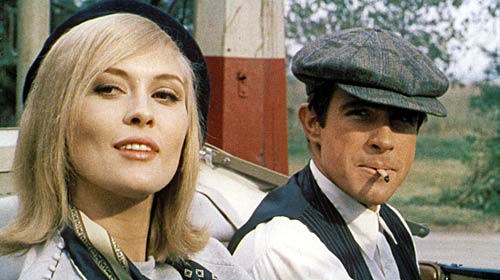
(8/10/11) As she changes in her room, Bonnie Parker glances out of the window and notices a young man attempting to steal her mother's car. She runs out to stop the man and is immediately attracted to his handsome charm and reckless nature. Clyde Barrow then takes her into town where he robs a grocery and steals a car and she is immediately hooked. Becoming her partner in crime, the two engage on a spree in the southwest where they rob banks and take on a mythic Robin Hoodlike image. Teaming up with a dimwitted mechanic, Clyde's brother Buck and his wife, the two head down a wild and dangerous road that can only end in tragedy. Director Arthur Penn's "Bonnie and Clyde" is a romanticized version of the famed outlaws. When released common folk authority scorning heroes struck a chord with counterculture film goers while startling many with its images of stark violence. Working from a script by David Newman, Robert Benton, and Robert Towne, the film contains wonderful direction by Penn, great editing by Dede Allen, and superb Oscar winning Technicolor cinematography by Burnett Guffey. Warren Beatty and Faye Dunaway share perfect chemistry in two roles for the ages and they are given wonderful support. Michael J. Pollard is wonderfully dopey as C.W. Moss, their idiot mechanic. Gene Hackman is great as Clyde's good old boy brother Buck. Estelle Parsons is wonderful in an Oscar winning role as Buck's flighty wife Blanche, and Gene Wilder, in his debut film, has a hilarious and ominous bit part as an undertaker the gang kidnaps. "Bonnie and Clyde" is a modern classic that changed both how heroes and violence were presented in mainstream movies, and at its most basic level, is a sublime example of filmmaking.