Showing posts with label 1944. Show all posts

Wednesday, October 31, 2018

The Lodger

While Jack the Ripper carries out his bloodthirsty slayings in Whitechapel, a Scotland Yard inspector (George Sanders) begins to suspect a peculiar tenant (Laird Cregar) at a neighborhood boarding house as being the infamous perpetrator. Meanwhile the would be serial killer casts his sights on a beautiful fellow tenant and concert singer (Merle Oberon). A remake of Alfred Hitchcock's breakthrough 1927 silent film, The Lodger is stodgy but atmospheric and chilling with several effective, memorable scenes and fine work from Oberon and Cregar.
*** out of ****

Friday, August 25, 2017

Lifeboat

Eight passengers man a lifeboat after their ship is torpedoed and sunk by a German U-boat, which is also simultaneously struck. When the sub's captain is pulled aboard, he is greeted with hostility and paranoia although his knowledge of the sea may be the only thing guiding the vessel to safety or peril. Confined entirely to the small craft, Lifeboat may be Alfred Hitchcock's most atypical work though it is creaky and plays almost like social theater of the era. An excellent cast buoys the production with standouts including Tellulah Bankhead as a spoiled and worldly journalist, William Bendix as a wounded traveler, Hume Cronyn as a novice sailor, and Walter Slezak as the shifty German.
*** out of ****

Wednesday, April 5, 2017

Gaslight

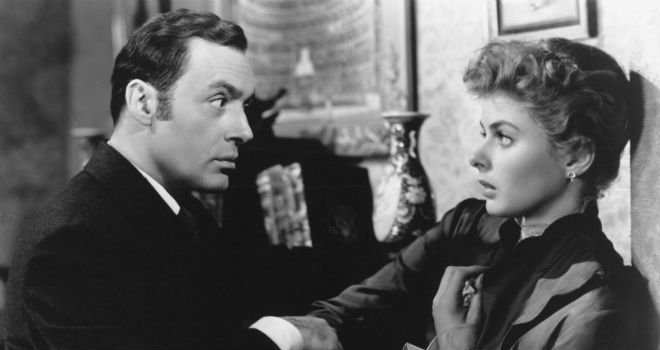
A fraught music student (Ingrid Bergman), still distraught at the murder by strangulation of her famed and beautiful concert hall singing aunt, takes up with her charming and unsavory conservatory instructor (Charles Boyer) as the couple moves back into the murder house where he deftly and gradually makes her believe she is going insane. George Cukor’s Gaslight is timeworn and rife for parody, though still retaining many superb qualities including splendid sets and crisp cinematography. Bergman is beautiful and confused as ever, Boyer is amusing as a manipulative worm, and Angela Lansbury stands out as a cockney maid in her first ever screen appearance.
*** out of ****

Monday, October 24, 2016

Cat People/The Curse of the Cat People

In the hands of director Val Lewton, Cat People is an extremely well made, atmospheric, and even scary RKO B-Picture with a plot detailing a Serbian immigrant who morphs into a cat whenever overcome with envy. The film feels dated, containing unintentionally amusing plot elements and virtually no story to speak of but still worth seeing for its tense shock sequences. It was followed up a few years later by Curse of the Cat People, a pointless, forced, and barely related sequel that still manages to maintain a strong visual sense.

Cat People: *** out of ****
Curse of the Cat People: ** out of ****

Wednesday, July 1, 2015

Laura

A police detective (Dana Andrews) investigating the death of a young woman (Gene Tierney) grows suspicious of her dubious associates, who include a fawning, jaded journalist (Clifton Webb) and her dupe fiancé (Vincent Price), while gradually falling in love with the victim. Otto Preminger's Laura is  a smart, cynical, and elegant noir, offering a compact, fast paced mystery and fine performances from Andrews, Price, and especially Webb.
*** 1/2 out of ****

Sunday, April 6, 2014

National Velvet

A bitter ex-jockey wanders the English countryside and is taken in as a farmhand by a family whom he soon plans to rob, but has his heart softened by their kind and indomitable horse loving daughter. After winning a wild stallion in an auction, the two train it to race and enter the powerful beast in the Grand National, with the young girl disguised as a male jockey. "National Velvet" is a gorgeous, sumptuous, and moving family spectacle. From overlooked director Clarence Brown, the film offered a young Elizabeth Taylor her first starring role in which she succeeds swimmingly, with Mickey Rooney starring opposite and providing an equally commanding performance. Supporters Donald Crisp and Oscar winning Anne Revere are delightful as Taylor's parents and the film is brimming with wonderful visuals, engaging scenes, and a whirlwind closing race. "National Velvet" is a family film of great entertainment and earned sentiment, the likes of which are virtually extinct today.

Sunday, December 23, 2012

Meet Me in St. Louis

In the months leading up to the 1904 World's Fair, the members of the Smith family prepare for the momentous occasion while weathering the ebbs and flows of love, following a bombshell that their father will move them to the dirty and overcrowded city streets of New York and away from their beloved St. Louis home. "Meet Me in St. Louis" is a delightful musical directed by Vincente Minnelli and starring Judy Garland,  and is the set on which the two first met. The film is an episodic, unpretentious, and comfortable with not overreaching, while featuring some very fine musical numbers. Garland turns in a sweet performance, Mary Astor and Leon Ames deliver fine turns as her parents, and Margaret Sullivan all but steals the show as the precocious, death obsessed youngest sister.

Saturday, April 28, 2012

Going My Way

A magnetic, young priest is sent to smooth over the replacement of the old cantankerous pastor of a Brooklyn Church. While handling the affairs of the struggling parish, the musically inclined padre also starts a choir with the troubled local youth and aides a wayward runaway. "Going My Way" is old-fashioned corn presented in a highly affable manner, and made all the more palatable by the amiable nature of Bing Crosby, the famous crooner in his Academy Award winning turn, and the enderaring performance of Barry Fitzgerald, also an Oscar winner, as the cranky old cleric. Director Leo McCarey's immensely popular film seems dated in some regards, and almost impossible to succeed today. Despite oversentiment and a few meandering moments, it is still a highly entertaining and nostalgiac film.

Wednesday, April 11, 2012

The Canterville Ghost

When a British aristocrat is injured and unable to duel, his bumbling brother is called on to defend his honor, who then scampers away in cowardice. For his act of pusillanimity, his father walls him up in a back room of the Canterville Castle until one of his descendants commits an act of bravery and frees his imprisoned ghostly soul. Fast forward to WWII where the matron of Canterville manor hat let her castle out for some American GIs to stay, and wouldn't you know it, one of the private happens to be a distant relative of the long suffering ghost. Now the blithering ghost along with a young resident of the manor must help the timid private find his footing when enemy troops mount a nearby attack. "The Canterville Ghost" is a wartime update of Oscar Wilde's short story and is a silly yet enjoyable excursion boosted by the very fine performance of Charles Laughton on the title ghoul, the affability of Robert Young as the timid GI, and some pretty inventive special effects.

Thursday, February 9, 2012

Ivan the Terrible, Parts I & II

"Ivan the Terrible" was legendary Russian director's last great work, yet also the film that put an end to his unprecedented career. Originally slated as a three part project, Stalin sensed the political undertones in the second film from Eisenstein's depiction of the secret police, and had the film banned and the series cancelled (Part II was released in 1958). Parts I and II of Eisenstein's epic are highly stylized depictions of the brutal of the czar, with Ivan's war against the aristoratic Boyars, court intrigue, murder of Anastasia, and revenge against his betrayers drawn in long shadow and sharp artistic details (a color shift during a celebration in "II" is both jarring and exciting). The cast members are seen as caricatures and Nikolai Cheraksov's wide eyed lead performance is something to behold. Strangely for a historical epic, "Ivan the Terrible" is a triumph of style over substance and a worthy, if incomplete swan song for a great master.

Tuesday, January 31, 2012

Jammin' the Blues

"Jammin' the Blues" is an Academy Award nominated short from 1945 which was admitted this year to the National Film Registry. It is a moody, free flowing, and innovative showcase of some of the great (and sadly) mostly forgotten Jazz legends including Lester Young, Harry Edson, and Red Callender. 

Friday, November 11, 2011

Henry V

William Shakespeare's Henry V has always been a rallying cry for the British people, often staged during times of war. So it is no surprise that Winston Churchill summoned Laurence Olivier from his stint in the navy to helm a production of the play. Filmed over a short period of time in beautiful Technicolor, Oliver directed, wrote, and starred in a rousing version of the play that aired in England at the same time of the invasion of Normandy, the same lands of which King Henry conquers in the play. The film begins as a performance at the Globe Theater in 1600 and the action onstage shifts to the fields of northern France in 1415 where the courageous Henry leads his men to victory in The Battle of Agincourt during the One Hundred Years' War. Like all of Shakespeare's work, it takes a minute to get a hold on the dialogue, but after a bit, this becomes a rhythmic and rousing affair. Olivier is commanding in the lead as he passionately recites scores of beautiful and energizing prose. Up until this point, Shakespeare was thought of as too stodgy for the big screen. With "Henry V", Olivier set the bar for the future films adapted from The Bard's work.

Thursday, November 10, 2011

Double Indemnity

A wounded insurance agent races through a red light in the early hours of the mourning and rushes into his agency where he dictates the events of the last few weeks of his life and how he became embroiled in his current predicament. Beginning with a trip to renew a man's auto policy, the agent becomes enamored with an icy blond and entangled in a murderous insurance scheme, with his keen and dogged boss always on the scent. Billy Wilder's "Double Indemnity" may be the finest example of film noir to ever grace the big screen, and with a script from a novel by James M. Cain ("The Postman Always Rings Twice", "Mildred Pierce") and contributed to by fellow hard boiled author Raymond Chandler ("The Big Sleep", "Farewell, My Lovely") and given Wilder's crackling writing style, it should be of no surprise. The dialogue that populates the film is terse, witty, and cold and is given greater weight through Fred MacMurray's deadpan delivery as Walter Neff (with two f's as in Philadelphia). He is matched by the beautiful Babraba Stanwyck as the heartless and calculating Phyllis Dietrichson. Edward G. Robinson is wonderful as well as MacMurray's boss, in the role that ushered him from leading man to supporting player. In addition to the great dialogue and crisp black and white direction, one of the great things about the film is how well the crime is spelled out and how plausible every character's involvement and motivation is. "Double Indemnity" is a success on several different levels and another triumph on the incomparable Wilder's list of successes.

Thursday, October 6, 2011

To Have and Have Not

An American running a fishing charter in the Caribbean Isle of Martinique romances a young lounge singer and reluctantly becomes involved with the French Resistance. "To Have and Have Not" is Howard Hawk's adaptation of what he thought to be Ernest Hemingway's worst novel. Scripting with William Faulkner and Jules Furthman, the story is sleepy and in more ways than a few resembles "Casablanca". However, the film is largely of note due to it being the debut of Lauren Bacall and the beginning of her relationship with Humphrey Bogart. The two sizzle on screen together and the film is pretty remarkable in that we are watching what is probably a record of the two falling in love. There are other meritorious elements in the picture as well. Bogart is great as usual, Bacall is extremely sultry, and Walter Brennan is a hoot as Bogie's first mate. There are some good musical numbers between Bacall and Hoagy Carmichael as well. "To Have and Have Not" is a laid back picture, yet a curious one and entertaining at that.

Sunday, July 3, 2011

Murder, My Sweet

Philip Marlowe is in a tough spot. A handful of people involved in a missing persons he was investigating are now in the morgue and the hard boiled P.I. is a prime suspect. With bandages over his eyes, Marlowe explains to detectives how his case involving a hulk of a man searching for his old flame evolved into a case of multiple murders involving local gangsters, a millionaire, and his sultry young wife. Directed by Edward Dmytryk, Murder, My Sweet is a nice little twisty detective noir from the Raymond Chandler novel Farewell, My Lovely. Dick Powell, who oddly plays Marlowe in a lightly comic fashion not at all resembling Humphrey Bogart's version, is surprisingly effective. I enjoyed the twists and turns of the plot in this movie that gets more and more engaging up until its wonderful ending.