Showing posts with label 1971. Show all posts

Friday, January 19, 2018

10 Rillington Place

From a true crime story about an achingly terrifying miscarriage of justice, middle-aged serial killer John Christie (Richard Attenborough) lives an unassuming life with his wife in their quiet London flat when he decides to rent the adjoining property to an illiterate laborer (John Hurt), along with his wife and infant child, who will soon face the hangman’s noose for one of his landlord’s unspeakable crimes. Filmed just doors down from the site of the actual killings, Richard Fleisher’s 10 Rillington Place is bleak, muted, and understated with Attenborough creepily effective and Hurt totally credible in the tragic role.
*** out of ****

Monday, December 25, 2017

Mon oncle Antoine

In a rural, asbestos mining Quebec town in the late 1940s, a young teenager becomes a man while working in his uncle and aunt's general store/mortuary during the Christmas Season as he serves a funeral, spies on a female customer, flirts with the same-age adoptive daughter of his employers, and discovers the truth about his personal relationships. Claude Jutra's mischievous though subtle and sensitive Mon oncle Antoine, is a profound and insightful coming of age story crafted with an exacting point of view, camerawork, and music.
**** out of ****

Saturday, August 5, 2017

The Beguiled

A critically wounded Union soldier is discovered and taken into a Southern all-girls boarding school where he is reluctantly nursed back to health while he stokes the ire, passions, and curiosities of its residents. Don Siegel's The Beguiled is more diabolical and carnal than Sophia Coppola's recent respectable remake, made with a very 70s, hallucinatory aura, and a surprisingly talkative role for Eastwood who is quite, especially later on when his character becomes possessed with uncontrollable rage.
*** 1/2 out of ****

Sunday, February 12, 2017

WR -- Mysteries of the Organism

A documentary on controversial, radical analyst Wilhelm Reich is intercut with a Russian communist romantic drama on sexual repression  along with more docu-like interludes. Provocateur Dusan Makavejev's often banned WR -- Mysteries of the Organism is occasionally amusing but pointless and mostly exists as being bizarre and lurid for those sakes alone.
** out of ****

Thursday, September 15, 2016

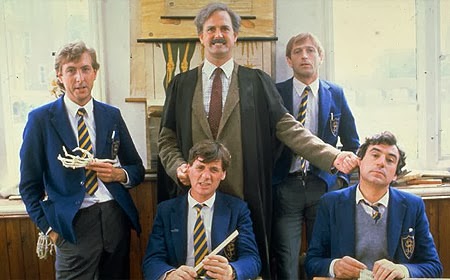
Flying Circus and the Python Films

It is difficult to describe the appeal of Monty Python, the irreverent and game changing British comedic troupe, when their irreverent material is as often inane and borderline unwatchable as it is uproarious. Nevertheless the appeal of the group, which consists of members John Cleese, Graham Chapman, Michael Palin, Terry Jones, Eric Idle, and Terry Gilliam and began on the stage and continued on through television and film, is undeniable and their influence on comedy is immeasurable. Here is a brief rundown of their work:

Flying Circus ran on the BBC between 1969 and 1974 with a feature film titled with the group's favorite segue And Now for Something Completely Different sandwiched midway in its run which took the odd approach of refilming some of their greatest hits without of the presence of a studio audience, the result of which is strangely compelling. The series has many regrettable sketches and running gags, and I feel I should keep my opinion on Gilliam's animations to myself in fear of being shunned, but it is absolutely worth suffering the dreck to get to their best and most outrageous routines (or you could just watch them on YouTube---my favorite bit is Palin's bumbling Spanish Inquisitor).

The gang followed up the series with Monty Python and the Holy Grail, perhaps the most widely seen of their features and what I'd personally consider the best of the lot. This silly take on the Arthurian legend has many indelibly hysterical moments and only starts to come apart at the seams towards the very end.

The controversy generated by Life of Brian, which tells the tale of the child born a manger over from Christ, catapulted the Pythons to international superstardom, but the film offers easy and obvious satire, with belabored gags, and laughs that are few and far between (though those few present are hearty). Gilliam's direction does achieve great period look (though his influence beyond that is distracting) and Palin's Pontius Pilate is unforgettable. Casting Chapman in the lead serves as a great disappointment considering what is lost in the supporting roles.

Time Bandits is not officially a Python movie but it was directed by Gilliam who cowrote the script with Palin and features cameos from both Palin and Cleese. The fantastical and occasionally creepy children's story deals with a band of dwarves in possession of a time travel map who take a neglected youth on their marauding journey through history. The film again falls apart towards the end but the actors are likable and the proceedings are worthwhile for the hilarious cameos, which also include Ralph Richardson and Sean Connery. 

Next up was Live at the Hollywood Bowl, a live show converted to film and released theatrically which consists of old sketches and new that comes off quite well leaving you pondering if their material isn't best suited for the stage. 

Meaning of Life, which takes a surreal look into each of life's stages, is a sporadically funny feature which is hurt by dark and atypically heavy dosages of cynicism and vulgarity. The short film that opens the movie is a highlight and the "Every Sperm is Sacred" number is priceless.

In 2014, the Pythons returned for a live farewell show of sorts, Monty Python Live (Mostly), which featured an array of live performances, clips old and new, and a musical revue, all with the participation of the remaining and surprisingly capable troupe members, save Graham Chapman who is roundly toasted during the performance.

Thursday, July 14, 2016

Macbeth

Made in the aftermath of the Manson killings that claimed his wife's life, Roman Polanski's take on Shakespeare's Scottish tragedy of the noble thane overcome with madness by visions of power and glory is a violent, atmospheric, visually exquisite mood piece, infected with a tinge of melancholy, and carried out sublimely by a troupe of unknown actors.
*** 1/2 out of ****

Monday, July 11, 2016

Diamonds Are Forever

Diamonds Are Forever, the last official Connery appearance as 007, is incredibly cheesy and stupid, though often fun and more bawdy than other series entries up to that point, with a plot involving some incomprehensible nonsense regarding Blofeld (a worthy portrayal by Charles Gray) supplanting a Howard Hughes type figure in a Vegas high-rise while using diamonds and cassette tapes to set off nuclear missiles.
*** out of ****

Sunday, May 22, 2016

The Last Picture Show

In a 1950s depressed, desolate small Texas town, a high school senior (Timothy Bottoms) cares for his impaired younger brother (Sam Bottoms) and romances the football coach's lonely wife (Cloris Leachman) while his best friend (Jeff Bridges) slowly realizes his days of courting the town's high class beauty queen (Cybill Sepherd) are quickly coming to a close. Their time is spent is spent either in the establishments of the weathered, principled and beloved Sam the Lion (Ben Johnson), which include a diner, pool hall, and the soon to be closed single screen movie theater playing the latest Howard Hawks Western. Peter Bogdanovich's adaptation of Larry McMurtry's novel, brilliantly directed in grainy black and white, is a perceptive, sage film made with frank honesty and featuring either tender or harsh, though all excellent performances from actors at the beginning, middle, and ends of their careers.
**** out of ****

Saturday, May 14, 2016

Land of Silence and Darkness

A look into the life of Fini Straubinger, an elderly deaf and blind woman who dedicated her life to advocating for those met with similar conditions. Werner Herzog's Land of Silence and Darkness is a captivating documentary with educational value that bears great camera footage that lengthily, and with what seems to be immense fascination on the behalf of its director, tracks the, at often times, enchanting behavior of its subjects.
*** 1/2 out of ****

Tuesday, January 26, 2016

Fata Morgana/Lessons of Darkness


Fata Morgana, 1971
Lessons of Darkness, 1992
In 1971, Werner Herzog sought out to make a science fiction film in the Sahara Desert which was later abandoned but resulting in a landscape documentary of the unforgiving, arid region known as Fata Morgana. Twenty Years later the maverick director visited the combustible fields of post Gulf War Kuwait for another similarly haunting apocalyptic documentation. Herzog has spoken of the cinema being devoid of memorable images and his films are known for being comprised of a bizarre array of them, but here these two similar documentaries contain only images and are devoid of narrative and anything else resembling traditional storytelling. Still, both are beautifully shot and even poetic, and, like many of his films, have a certain evocative, ethereal quality.

Saturday, January 16, 2016

Bananas

Jilted by his activist girlfriend, a neurotic products tester (Woody Allen) becomes politically active and finds himself leading a Central American revolt. This early zany Woody entry is hit or miss (largely leaning toward the latter although the concluding court scene is a riot) like a lot of his early straight comic work and though the film is loved by many, it speaks more towards the attempts of a great writer/director attempting to gain footing and his style and skills.
** 1/2 out of ****

Sunday, May 17, 2015

The Panic in Needle Park

After being dumped by her scumbag boyfriend and procuring an abortion, a naïve young woman (Kitty Winn) takes up with a heroin addicted street hustler (Al Pacino) who hangs out in the titularly dubbed Upper West Side neighborhood where other addicts congregate. Soon she herself is using, whoring herself out, and fighting drug charges with her new beau. Jerry Schatzberg’s The Panic in Needle Park, with a screenplay by Joan Didion and John Gregory Dunne from a novel by James Mills, seems to really know and understand its urban junkie turf, but suffers from its own persistence at realism and grows incredibly wearisome after a while. Pacino is strong and completely credible in his debut leading screen performance and Winn, unfortunately, is not.
** 1/2 out of ****

Friday, February 20, 2015

The French Connection

During a routine drug bust, NYPD narcotics officers Popeye Doyle (Gene Hackman) and Buddy Russo (Roy Scheider) learn that 32 million dollars worth of heroin has been smuggled over from France and begin the laborious, frustrating, and deadly search for the shipment and its source. Whether its a barroom bust-up, a sleepy stakeout, or the ultimate elevated train chase sequence, William Friedkin's gritty, exciting, and quintessential action picture elevates itself above the rest mainly due to the way it treats its audience like adults and not feeble minded idiots. Hackman provides a tough, uncompromising, unlikable, and atypical leading man and Scheider is equally compelling as his partner.
**** out of ****

Tuesday, April 22, 2014

Klute

An uncorrupted detective (Donald Sutherland) from rural Pennsylvania  travels to New York City to investigate the disappearance of a local businessman, his only contact being a high rent prostitute (Jane Fonda, an Oscar winner). When his missing person turns out to be a thread in a string of murders, he becomes his new acquaintance's protector and then lover as she becomes the bait to lure the deadly killer. Klute is a well made, typically murky, and often frustrating Alan Pakula film that fits in nicely alongside some of the other thrillers he made in that time frame (The Parallax View, All the President's Men). Fonda is assuredly powerful and sexy and Sutherland makes a nice counter as her introverted partner.

Thursday, February 13, 2014

McCabe & Mrs. Miller

(spoilers herein) An arrogant cardsharp (Warren Beatty) opens a gambling joint in an upstart western mining city so young that it barely has the frames of its houses filled it. When a beautiful, classy prostitute (Julie Christie) convinces him he needs her expertise to oversee his whorehouse, he finds in her both a business partner and an awkward lover. However, when his bustling operation comes to the attention of a large mining company, whose negotiating agents he refuses to play ball with, McCabe finds his livelihood and personal well being in the hands of a ruthless band of mercenaries. With its beautifully lit photography, very human performances from Beatty and Christie, and a screenplay interested foremost in the sociological behavior of its characters, Robert Altman's McCabe & Mrs. Miller is a western that is so distinct and well-defined, it places itself in a class apart from other entries in the genre. It also features several haunting icy demises, namely the finale and Keith Carradine's senseless, unforgettable rope bridge execution.

Sunday, January 12, 2014

Play Misty for Me

The DJ (Clint Eastwood) of a coastal California radio station receives the title tune request from the same caller on a regular basis during his nightly slow jazz program and shrugs it off with a smile, dismissing the repeat caller as another lonely romantic. While in a bar one night (and on a break from his sweet girlfriend, played by Donna Mills) he is picked up by an assertive female (Jessica Walter) who becomes increasingly difficult to shake following their one night stand and demonstrates disturbing and escalating personality defects when she finally begins to get the picture. Playing a character Eastwood has said is closer to himself more so than any of the other more famous and macho personages he's depicted over his lengthy acting career, Play Misty for Me is a nice little, surely made thriller, his first in an equally distinguished career as a director (his mentor, the director Don Siegel, appears in a recurring cameo as a bartender). The overblown stalker story, which would have been presented cheaply and artlessly 99 times out of a 100, is competently done, with some fine touches added on (the Edgar Allan Poe connections in the denouement are particularly inspired). Clint is assured in his role and Walter, who is probably better known to modern audiences as the mom from Arrested Development, brings potency to her maniacal role.

Saturday, March 9, 2013

Get Carter

Upon hearing of the death of his brother, a heartless London gangster travels north to Newcastle to exact his revenge on the parties responsible and rescue his niece from the pornographers whose company she has fallen in with. "Get Carter" is a tough minded, no nonsense neo-noir picture from director Mike Hodges which contains many scenes of abrupt and almost forced violence. Michael Caine demonstrates what a good actor he is in his portrayal of a totally callous and detached executioner, which may have been hard to believe in the hands of another performer.

Wednesday, August 29, 2012

The Anderson Tapes

When a safe-cracker, just sprung from prison after a ten year stint, borrows money from the mob to finance his latest operation, a burglary of every tenant in a posh Upper East Side flat, he finds himself being monitored from more angles than one, by a slew of government agencies looking to bring down his backers. "The Anderson Tapes" was adapted for the screen by Frank Pierson from Lawrence Sanders book, where it received a fairly inert treatment by master director Sidney Lumet in the film that reunited him with his "The Hill" star Sean Connery who is enjoyable in the lead role as the know nonsense and seemingly dimwitted ex-con. There are also some other notable performances here: Martin Balsam as a queen/fence, comedian Alan King playing a mob boss, and Christopher Walken in his film debut. The film itself though never seems to gel completely, and moves sluggishly until its fantastically clever closing scenes.

Tuesday, September 6, 2011

Harold and Maude

Harold is a death obsessed 20 year who likes to stage fake suicides and attend funerals. Maude is a free spirited eccentric on the verge of 80 who enjoys nude modelling and engaging in minor crimes. Naturally the two meet and fall in love. Harold and Maude is a movie founded on an incredibly creepy premise that is handled extraordinarily well by writer Colin Higgins who employs both humor and subtlety. Directed by Hal Ashby, one of the great and highly unappreciated directors of the 1970s, he stages and frames the film exceedingly well. Bud Cort and Ruth Gordon are fine in the leads and a delightful soundtrack provided by Cat Stevens guides the way in this surprisingly pleasant film.

Wednesday, August 3, 2011

Straw Dogs

A pacifistic mathematician receives a research grant and leaves turmoil ridden America with his wife to live in the British countryside where she grew up. In their pastoral and seemingly peaceful village they receive increasingly alarming harassment from the locals which builds up into a situation where he must embrace the harsh violence he has so vehemently rejected. Straw Dogs is another take on the subject of violence by Sam Peckinpah, the director who was so consumed by it and determined to see its true nature presented on the screen. Dustin Hoffman delivers a stellar and totally identifiable performance as we watch his character's journey from cowardice to courageousness as he endures torment not only from the vicious townspeople but also from his tempestuous wife. The movie is thoroughly engaging and several segments grab hold of your attention like few films I seen. Some scenes do get out of hand, such as the extended rape scene, which shows Peckinpah's misogynistic side, and the final scene in which Hoffman defends his house, which although satisfying, is overly violent and counteracts the rest of the more subtle film. Straw Dogs is absorbing statement on violence containing a decisive performance from Dustin Hoffman which should speak to anyone who watches it.