Showing posts with label 2012. Show all posts

Thursday, August 31, 2017

Game of Thrones

It is difficult to review television without giving away something of the plot. Tread lightly if you haven't seen the series in its entirety.

Season 7 (2017)
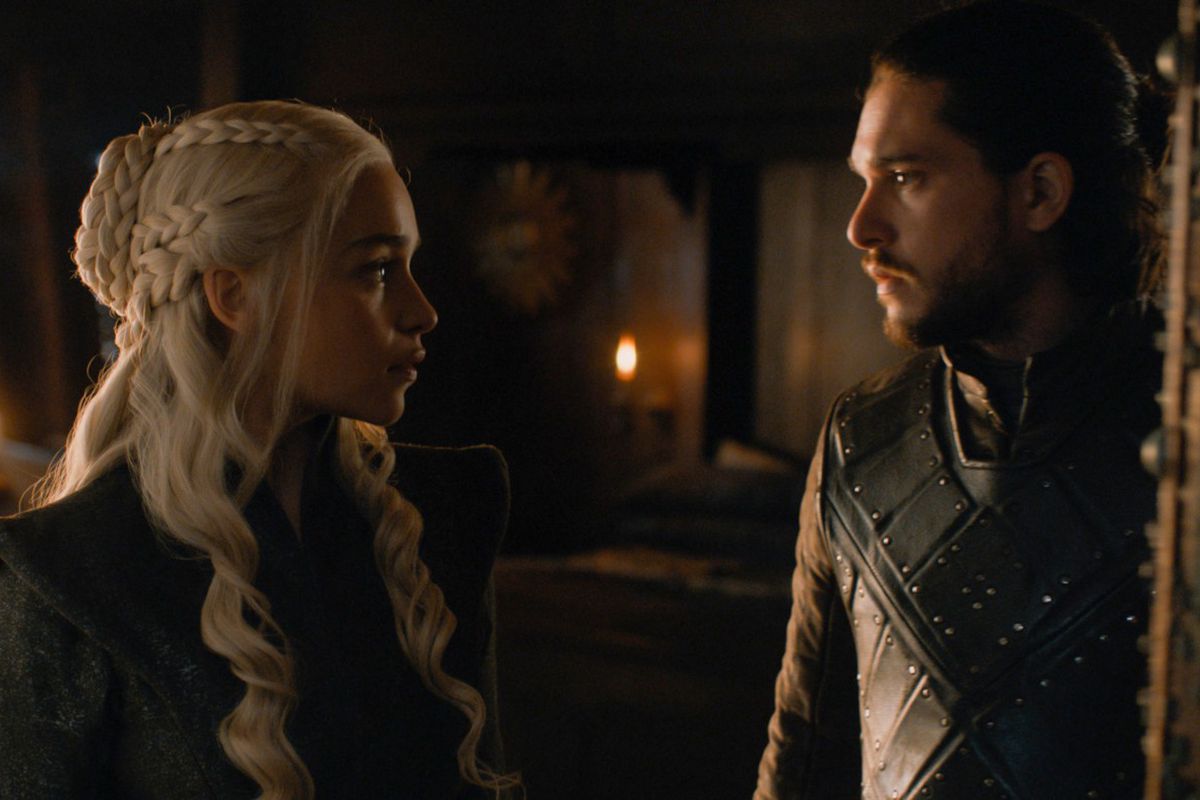
As the threat from the White Walkers grows ever more imminent, Jon and Daenerys finally acquaint as they quarrel over patronage before coming to terms with an alliance and a potential love affair and Cersei and Jaime prepare for war at King’s Landing while the surviving stark siblings have a bitter reunion at Winterfell as Littlefinger’s presence ominously looms. As the end nears in this first half of the final season, the pace is quickened, the storylines converge, and the number of battle sequences increase, the series is still bogged down by unnecessary asides, woeful plotting and characters, absolutely insipid dialogue.
** 1/2 out of ****

Season 6 (2016)
Cersei plots revenge while sitting back helpless in humiliation as her son is taken in by the High Sparrow and the gods, Arya learns some harsh lessons in life and death, and Sansa, after being rescued by an unlikely source, reunites with an unsurprisingly resurrected and differently composed Jon as they gear up to retake Winterfell from the odious Ramsay Bolton. In this first season without George R.R. Martin as a writer and as the series eyes the finish line and moves all of its pawns into place, it is nice to see the pace finally pick up with so much finally happening in this multi-storied universe, with also some incredible set pieces to boot in the latter episodes. Still the quality of the dialogue seems the worst its ever been, some stories still seem stuck in limbo (i.e. Daenerys and Tyrion), while Arya's would be powerful tale comes off as insipid and disappointing.
*** out of ****

Season 4 (2014) and Season 5 (2015)
An act of treachery at the Royal Wedding sends Tyrion toward a new destiny and Sansa into greater peril. Daenerys learns how to rule over the recently liberated Meereen and Stannis provides relieve to the Night's Watch only to find more obstacles on his quest to the Iron Throne. The fourth season of Game of Thrones is a marked improvement over the previous one, with the intrigue at King's Landing exciting enough to cover for the dull wheel spinning that continues to go on elsewhere (i.e. The Wall, Meereen), only to return for a dreadful, monotonous fifth season that brings nothing closer to resolution except in killing off several major characters in the end, which surely will thrill many fans but seems a giant waste of their protracted storylines. Without having read the books, it almost seems as if George R.R. Martin crafted an excellent first entry, which was then adapted into a great first season, and then had absolutely no idea what he signed on for or where it was going after that. While watching the "previously on" segment for Sunday's finale I realized that I had never seen a show with so much going on where so little actually happens.
Season 4: *** out of ****
Season 5 ** out of ****

Season 3 (2013)
As the inhabitants of King’s Landing recover from the their costly victory at the Battle of Blackwater and Stannis and his few remaining followers lick their wounds on a remote island, war parties led by Rob Stark and Daenerys Targaryen continue their arduous march on the capital. I wanted to keep this short and sweet after feeling the ire from panning another highly popular show, but season three represents an even steeper decline for this beloved series and, even in the “Golden Age of Television” as many have dubbed it, provides further evidence of the difficulties of sustaining an extended serial, even one based on extensive source material. You can almost picture George R.R. Martin and the HBO execs sitting at their round table brainstorming their smoke and mirrors tactics saying, “You know, we could just go through with a long, boring, protracted season where things wind up basically where they started, so long as we kill off a few major players in the end, we’ll still have ‘em hooked.”
** out of ****

Season 2 (2012)
As three challengers to the throne march upon King's Landing, an unexpected foe lays siege on Winterfell, causing more turmoil and heartache to the already beset Stark family. Tyrion has his hands full as Hand of the King in dealing with his treacherous sister and malevolent nephew. Daenerys, her dragons, and dwindling tribesman remain stranded across the Narrow Sea and Jon Snow begins his tour beyond the Wall as the dreaded Winter finally arrives. Following the spectacular first season of Game of Thrones, the followup series, while still maintaining a high level of interest, meanders and goes in circles for many of its story lines, and ones which were the top draw in season one (ie Daenerys, Jon Snow and the Wall, Rob Stark and his army) now seem to have lost their way and are stuck in standstill for virtually this entire round. Also, following the exit of Sean Bean, the show does not have a lead actor to anchor itself around and while Peter Dinklage (who went from Best Supporting Actor Emmy Winner to first billed in the credits) is excellent, he is not a leading man. I was still engaged with this season. The court intrigue and Arya's storyline worked best for me but the show seemed only interested in its primary story, which was made evident in the climactic Battle of Blackwater episode. "Game of Thrones" is a vast drama, and about as in depth as anything you can expect from television that still nonetheless needs to iron out its storytelling kinks.
*** out of ****

Season 1 (2011)
A long and brutal winter is approaching the kingdom of Westeros and treachery is afoul as the Hand of the King has been murdered. Surrounded by the cunning and powerful family of his duplicitous wife, King Robert Baratheon sends for his old friend and battle mate Eddard Stark to take up the position of the deceased and be unwillingly hurled into the deadly title scheme. The HBO adaptation of the George R.R. Martin novels is an excellent entry in the fantasy genre, simultaneously telling an involving, intelligent, violent, but grounded other worldly tale. Filmed throughout Northern Ireland and Scotland, as well as in parts of Morocco, the series features the most stunning visuals to be found in any television series. Its epic cast of mostly British players is uniformly excellent and if forced to select a handful as my favorite I would chose Iain Glen as a courageous exiled knight, Emilia Clarke as his queen and charge, samely exiled, Peter Dinklage as a witty and underestimated dwarf, and Sean Bean as the noble, sullen Eddard Stark. "Game of Thrones" is wonderfully engaging entertainment that isn't afraid to break the "rules" of television and has characterization and intelligence to match its harsh tone and violence.
*** 1/2 out of ****

Wednesday, June 15, 2016

Koch

Shortly before his passing in 2013 at age 88 and while still seeming to be very active in politics, film criticism, and Manhattan daily life, former three termed NYC mayor Ed Koch takes us through his storied and colorful reign that oversaw a transformation of the crumbling megacity. Neil Barsky's profile is informative, stirring at points, and aims to be fairly told even though it doesn't quite know how to wrap.
*** 1/2 out of ****

Sunday, April 3, 2016

Boardwalk Empire

Season 4 (2013) and 5 (2014)
As Nucky makes peace arrangements with Rothstein and Masseria, he pursues new business interests in Florida while being strong armed by a Harlem gangster, pursued by a crooked agent of the Justice Department, an targeted by an increasingly ambitious and ruthless Luciano. In a detached story, as his reign comes to an end, we learn Thompson's rags to riches tale of how he became Treasurer of Atlantic City. The 4th season of Boardwalk Empire is still watchable yet a far cry from where it stood in its first few runs. Wright is a disappointing and ineffectual villain, new cast additions either fall flat (Brian Geraghty, Eric Laden) or are poorly utilized (Patricia Arquette, Ron Livingston). Shea Whigham is a standout among the principal cast. The 5th and final, abbreviated outing marks a great disappointment with the showrunners appearing to take up a task (an admittedly difficult one) that was beyond them with no idea where to go. A leap forward in time meshed with a horrid backstory topped off with a pathetic, barely thought out finale was sadly where signs had been pointing for the drama and should serve as a lesson for anyone attempting to do serialized historical fiction.
Season 4 : *** out of ****
Season 5 : ** out of ****

Season 3 (2012)
As New Year's Eve 1922 is celebrated in Atlantic City, Nucky's (Steve Buscemi) decision to constrict his bootlegging practices offends a highly volatile (and easily offendable) gangster (Bobby Cannavale) who commandeers a nearby suburb and sets his sights on A.C. On other fronts, Margaret (Kelly Macdonald) enjoys her newly acquired duties at the local hospital, though her seeds of dissatisfaction will germinate through the course of an affair with her husband's subordinate (Charlie Cox). Gillian  (Gretchen Mol) continues to scheme and grieve following her loss, Van Alden (Michael Shannon) attempts to establish himself in an unfriendly Windy City, and Richard (Jack Huston) may have found a solace he could have never imagined since attaining his war injury. "Boardwalk Empire's" third go round features some of the most dazzling visuals and fancy camerawork the series has had to offer, but is the most slight in terms of plot. The aforementioned subplots, in addition to others, hold interest in their own right, but often feel like filler and as not contributing to the thrust of the plot. Newcomer Cannavale is excellent though, and his explosive presence offers many alternately humorous and terrifying moments to the series. Also a body ridden season finale is not nearly as satisfying as the pulse pounding episode that preceded it.
*** 1/2

Season 2 (2011)
With a coup underway to oust Nucky, both Jimmy and the targeted treaurer's brother Eli walk a treacherous path, dealing not only with devious gangsters but also a crippling strike by the African-American community at the heart of the summer season. On top of his legal problems, Nucky faces personal problems as a discontented Margaret, now grief ridden after her daughter has been stricken with polio, finds solace with the local parish priest and in overly generous offerings to the Lord. The second season of "Boardwalk Empire" is an almost unfathomable continuation of excellence, somehow maintaining the same cinematic level of greatness achieved in season one. Steve Buscemi turns in a wonderful, nuanced performance which is unlike any other gangster portrayal, at least that I've ever seen. Michael Pitt contributes affecting award worthy work as the cheerless and deceitful Jimmy and Kelly Macdonald is still incredible in the complex role of Margaret. In an impeccable supporting cast, Michael Shannon stands out as the dogged federal agent whose story takes more than a few unexpected turns and Shea Whigham as Buscemi's frustrated, overlooked brother. With its alternately beautiful, brutal, and affecting methods, "Boardwalk Empire" achieves an excellence in television that no other series, with the exception of "Mad Men", even remotely approaches.
****


Season 1 (2010)
Usually I keep television shows out of the blog, but I feel Boardwalk Empire is a series that approaches great film and, while watching, it feels like a solid 12 hour movie. This should come as no surprise since the show is brought to us by legendary filmmaker Martin Scorsese. He directed the first episode, offering the blueprint for the subsequent episodes. He also produces and consults on other aspects of the show. Boardwalk was created by Sopranos veteran Terrence Winter and he brings along other members of that great show. Again, we have a show set in New Jersey, this time in Atlantic City and again we follow professional criminals who drink, screw, curse, lie, cheat, steal, swindle, and murder. We follow several story threads and the main character is AC treasurer Nucky Thompson played by a finely tuned Steve Buscemi. This is not another Tony Soprano, as Thompson has more of a soft spot. This doesn't mean that he isn't capable of carrying out heinous acts. We meet a young Irish widow (Kelly McDonald) who comes into his life and also Jimmy (Michael Pitt) and young enforcer he sees as his own son. The story mixes real characters with fictional ones and all are played by fine actors: Michael Stuhlbarg plays Arnold Rothstein, the New York gangster who becomes at odds with Nucky and his crew. His segments are a highlight of the show and wonderfully acted by Stuhlbarg. Michael Shannon plays an agent and religious zealot on the hunt for bootleggers. We also meet characters such as a hot headed Al Capone, Lucky Luciano, and Warren G. Harding. Boardwalk Empire is also a visual success and a screenwriting success. In an era when ignorance passes for good television, this show is like a breath of fresh air. I urge you seek it out on DVD or on reruns on HBO.
****

Saturday, April 2, 2016

The Hobbit Trilogy

Well into his later years, living in simple comfort on the Shire, Bilbo Baggins begins writing the tale of his epic journey when an old wizard recruited him to aid a gang of motley dwarves in reclaiming their once prestigious homestead, now completely obliterated by a treacherous and seemingly insurmountable dragon. Peter Jackson's "The Hobbit" shares many of the positive attributes of the Lord of the Rings series including great scenery, musical score, elements of comradery, the presence of Ian McKellen and Andy Serkis in their now iconic roles, and even adds to the mix a more quickly paced plot line and an ideally cast Martin Freeman as the young Bilbo Baggins. It does though contain the same propensity for overblown all-inclusiveness, with Jackson never knowing when to quit, and promises to be just as protracted as the initial series (we barely even get a glimpse of Smaug here). Furthermore, although we thankfully see very little of the intolerable title creatures, the dwarves are more than happy to take up their headache inducing mantle. But these quibbles could be chalked up to a matter of my own personal taste and will surely be embraced by fans of J.R.R. Tolkein's book and the prior film installments. What certainly (and sadly) damages the film is Jackson's decision to shoot at 48 frames per second which adds very little, if anything to the 3D process (which was sighted as the reason for filming at that rate) and gives the film an ugly gloss and moves with the fluidity of a video game. This is all the more disappointing when reflecting on the first movies and that seamless blend of live-action and CGI,  and how we've only made a few strides on another bombastic excursion.
An Unexpected Journey (2012): ** 1/2 out of ****

The second and third installment of The Hobbit trilogy checks in once again with Bilbo, Gandalf, an increasingly ego inflated Thorin Oakenshield, and the rest of the barely defined dwarfs as they gear up for a showdown with the destructive Smaug and the more dastardly prospect of all out war. The Desolation of Smaug drops the unnatural, video game feel of the first movie and thankfully returns to the faithful form of the LOTR movies, yet is still meandering, never getting to the point, and moreover, again leaves you questioning why the book deigned this mammoth treatment. The Battle of the Five Armies is very watchable but still feels very unnecessary with (spoiler) Smaug oddly meeting his demise before the opening credits role and the rest of the film revolving around the anticlimactic eponymous battle. Also, Martin Freeman is regrettably absent from most of film. To sum it up, what count have been a tidy little Tolkein victory lap for Peter Jackson was instead both a bizarre, bilious experimentation (at first) and a bloated, unending, and overblown journey.
The Desolation of Smaug (2013): ** 1/2 out of ****

The Battle of the Five Armies (2014) ** 1/2 out of ****

Monday, December 21, 2015

Homeland

(Spoilers Ahead. This whole show is a series of spoilers, so be forewarned)
Season 5
We now find Carey living happily in Berlin, no longer with the agency and working for a private firm. Still her life remains in danger do a classified documents leak and the actions of a compromised agent, who also casts suspicion on Saul and places Quinn in direct contact with a terrorist cell who are planning an imminent strike. Season 5 represents a major setback for the series, one which has shown glimmers of rebounding but has never been able to consistently find its footing as storylines wear thin and fail to gain traction. Cast addition Miranda Otto is a highlight of the season , despite the ludicrosity of her far-fetched character.
** 1/2 out of ****

Seasons 3 and 4
Season three picks up with Carrie being the subject of Senate Investigation following the catastrophic attack on CIA headquarters, Brody seeking asylum in South America, and his family grappling with the horrific act. The fourth season sees Carrie named station chief in Kabul where she is faced with a Benghazi-like invasion and a hostage situation involving her mentor Saul. Following the outlandish second outing, Homeland returned with an intense, exciting, though still nonsensical third season, with superfluous domestic scenes at the Brody household taking away from the focus of the show. The fourth series is somewhat lacking and, due to the "terror threat at home" nature of the program, loses something by being set almost entirely overseas. Rupert Friend shines in support.
Season 3: *** 1/2 out of ****
Season 4: *** out of ****

Season 2
Following the botched attempt on the Vice President's life, Brody is now learning the ropes as a freshman U.S. Congressman while Carrie, teaching English as a second language and recovering from her stint in the booby hatch, is contracted by the CIA to lend her expertise to an expedition in Beirut. As Abu Nazir moves his pawns into place for his next terrorist attack, Carrie and Brody's stars align once more, placing their careers and lives into imminent danger. It becomes clear that the high-wire act done so well during the first season cannot be maintained, and while all the pieces don't quite come crashing down, preposterous plotting  has seized the day. Clare Danes character, where she was so effective before, has become nearly intolerable, going into hysterics several times an episode. Damian Lewis is doing what he can, and I think he should be commended for going through some of the things they put his character through with a straight face. Perhaps the most disappointing aspect of the show is how insipid Mandy Patinkin's Saul has become and the addition of Rupert Friend adds very little, if anything to the series. Most of these complaints can be chalked up to the writing. How could anyone seriously expect the show to maintain its momementum? And while the leads still maintain rooting interest, the second season plays its cards way too fast and serves them up in ways we can't possibly accept.
** 1/2
sidenote: As the "Homeland" season finale concludes the shows I watch for the year, I feel obliged to comment on the disappointment of nearly every series I've followed this year, especially one's in their sophomore season ("Homeland", "Games of Thrones", "Downton Abbey", "Sherlock"). In what has been termed as a "Golden Age of Television", these and other fan favorites such as "Boardwalk Empire" and "Breaking Bad" make it seem like a low karat era.

Season 1
A Marine (Damian Lewis) is rescued after eight years of being held captive in an Iraqi compound, and returns home to much fanfare and great difficulty adjusting to domestic life. Meanwhile an ambitious, volatile, and surreptitiously bipolar CIA agent (Clare Danes), having been informed several months prior by an al-Qaeda bomb maker that an American POW has been turned, suspects the heralded Marine of being the conduit of the next terrorist plot against the United States. "Homeland" is an ingeniously plotted tightrope act, which seems doomed to fail but never looses its footing once. Developed from the Israeli series "Prisoners of War" by Howard Gordon and Alex Gansa, who take their unlikely story to an intense, sheerly believable level because they always prioritize the human elements. Ten years after his tremendous work on "Band of Brothers", Damian Lewis returns with another powerful performance in a uniquely American role. As the unorthodox agent running a one person operation, Clare Danes is excellent and has some heartbreaking, almost unbearable scenes later in the season. Mandy Patinkin also contributes tremendous, nuanced work as a veteran operative and mentor/counterbalance to Danes. The plot description for "Homeland" makes one think of something destined for a short-lived run on network television, but due to the intelligent and sensitive writing (I can't stress this enough) and its endearing, perfectly realized cast, the first season is something of a wonder.
****

Monday, May 18, 2015

Mad Men

SPOILERS abound. Again, its hard to write about a serial without discussing the plot.
Season 7, Parts 1 & 2 (2014, 2015)
As the 60s fade and the 70s are ushered in, Don stares down another failed marriage, termination from his partnership, and his continuing, wayward calling existential crisis as SC&P faces consolidation into advertising juggernaut McCann Erickson. The final season of Mad Men travels down its own path, moving at its own speed, unconcerned with sensationalism, histrionics and easy resolutions, and providing its characters with deserving, surprisingly uncynical, and even tender endings. While so many shows seem to lose steam, spinning their wheels long after ideas or interest has run out, Matthew Weiner’s unprecedented series remained continually assured, surprising, intelligent, and engaging, a glowing example of how good television can be.
**** out of ****

Season 6 (2013)
It is a tumultuous 1968 and Sterling Cooper Draper Pryce finds itself chasing several major accounts while being party to a major merger. Pete Campbell finds himself several outrageous entanglements, one involving his mother and a new mystery man at the agency. Peggy finds her stock rising, yet still subject to the whims of the male colleagues, and Don continues his tumble into the abyss, engaging in a tryst with a neighbor that results in what may be his ultimate low point. What can be said about Mad Men that hasn't already been said. This latest season is a continuation of excellence that hasn't wavered since its foundation. All the excellent elements (acting, story, production values, etc.) are still intact and the addition of James Wolk playing Bob Benson, another charming, alliteratively named abstruse ad man adds some more fun to the proceedings. Watching this season, I realized how nice it is to be able to watch a show without worrying about its quality, knowing it will be great, and sitting back to enjoy the fall.
**** out of ****

Season 5 (2012)
Its 1966 and Sterling Cooper Draper Pryce has, quite quickly, revealed the monster it has become and how its depravity knows no bounds in the efforts seal a Jaguar clientele. Don continues his surprisingly faithful and seemingly empty marriage to Megan, Roger trips on LSD, Pete pursues an acquaintance's fragile spouse, Peggy reaches the end of her rope, as does Lane in a more literal sense following financial straits. After a long wait, the most brilliant series on television returns with a dark and brutal season as the audience along with the characters seem to get kicked in the teeth on a weekly basis. From the larger happenings discussed above to smaller ones, such as Paul Kinsey's pathetic return to Betty's weight problems, the sense of melancholy and longing seems deeper than ever. The cast is excellent once again. I liked where they took Peggy and Joan's stories this year, and Jared Harris was remarkable in where he was able to take his character throughout his run. In Season 5, Matthew Weiner gets closer to the heart (or lack thereof) of his characters and involves us once more in a sad and sinuous journey.
**** out of ****

Season 4 (2010)
1964 is coming to a close and Sterling, Cooper, Draper, and Pryce is struggling to take off. After bungling an interview with the New York Times, recently divorced Don Draper begins a decline where he sees the death of his friend in California, struggles with his drinking, and faces more problems with his secret identity. Peggy, Pete, and Joan face discontent at work while Roger's attitude towards a major client may just bring down the entire agency. Season 4 of Mad Men is a continuance of excellence for a show that started off wonderful and somehow seems to constantly get better. The regulars shine as bright as ever and there are some humorous new additions to the cast including a couple of buffoons in creative and an ambitious executive at a rival agency. Season 4 helps prove that television can be literate and entertaining at the same time and that most other shows aren't even trying.
**** out of ****

Season 3 (2009)
It's 1963 and the Brits have invaded Sterling Cooper. Shaking up management and making changes throughout the company, Pete Campbell and Ken Cosgrove are thrown into competition for the Account Manager Position. Don has acquired the desirable Hilton account but it may be more trouble than its worth. On the home front, his father-in-law comes to live with his family, a new baby has arrived, and an older gentlemen causes Betty to rethink their continually troubled union. Then, that sad fateful day in late November arrives when the world stops and reflects on the great tragedy that has befallen them. Season 3 of Mad Men continues the elegant melancholic brilliance that was established in the first two seasons. With pacing that is both leisurely and thoroughly exciting, Mad Men keeps raising the bar for television excellence. Matthew Weiner and his staff keep writing wonderful dialogue and situations and all the great actors, lead by the enigmatic John Hamm continue to wow as well.
**** out of ****

Season 2 (2008)

The second season of Mad Men picks up in the smoky and booze filled corridors of Sterling Cooper in the spring of 1962 with historical moon orbits, devastating plane crashes, high profile celebrity suicides, and the threat of nuclear war on the loom. As for the members of Sterling Cooper, a new executive will offer lofty promises, cost a tenured and liked exec his job, and possibly jeopardize the entire company for the sake of self promotion. Peggy Olson's career has skyrocketed while in her free time she reflects on the repercussions of her surprise pregnancy and has made the acquaintance of a young visiting priest. Ms. Halloway has become happily engaged but is somewhat discontented with her role at the office. Harry Crane has been made the head of the newly formed television department, Paul Kinsey has become involved in social activism with his new girlfriend, and Pete Campbell has found a way to capitalize on a family tragedy while struggling to conceive a child with his wife. Don Draper's affair with an older woman will lead to a separation from his wife, serve as an inspiration for boss Roger Sterling to leave his, and cause Don to head to California to do some soul searching which may lead to some answers regarding his mysterious past. Mad Men continues its excellency with wonderfully realized storylines and dialogue, while getting to the core of the discontent of its characters who seemingly have everything but who are still somehow empty.
**** out of ****

Season 1 (2007)

"How could anyone be unhappy with all of this"
So says Don Draper, the debonair advertising executive for Sterling Cooper, one of the most successful firms on Madison Avenue. Yet under the surface of the characters on Mad Men, the brilliant series by Matthew Weiner, lies a melancholy and a desire for something other than the items they superficially promote. With the smell of change in the air, Sterling Cooper's executives are something of a dying breed as they drink, smoke, engage in infidelities, and occasionally put in some work hours and draw in clients while the women wish to succeed on their own but seem hopelessly dependent on men in a male dominated world. At the top sits Draper (Jon Hamm), a natural at his job and a good family man as well. Regardless, his beautiful wife (January Jones) seems unhappy, has childish tendencies, and has recently been placed in psychotherapy. He doesn't seem contented, and sees his way into the arms of a Greenwich village woman (Rosemarie DeWitt) who hangs around beatniks. Also, developments occur that suggest that he may not be who he says he is. Then there is Peggy Olson (Elisabeth Moss) the perky and intelligent secretary with greater ambitions but seems to fall prey to the advances of Pete Campbell (Vincent Kartheiser), the snaky junior executive who will stop at nothing for self-advancement. Overseeing are the partners Roger Sterling (John Slattery) and Bertram Cooper (Robert Morse), the former more concerned with boozing and womanizing and the latter a pragmatist and seemingly straight and narrow kind of guy. Mad Men is a show that is intimately familiar with its time and setting, and it shows in the resulting period detail. The actors are wonderfully cast and believable in their roles. It is brilliantly conceived and intelligently written and sets the bar for what primetime television should be.
**** out of ****

Thursday, April 23, 2015

Lola Versus

In the midst of wedding arrangements and the onset of her thirtieth birthday, Lola (Greta Gerwig) is dumped by her fiancé and encouraged by her friends to recover and stake her claim in the world. Lola Versus is the kind of toothless, tepid hipster indie filmmaking that has come to dominate the market, here with Gerwig loosing much of her usual appeal in a film bearing several similarities to Frances Ha, but little of its wit and style.
** out of ****

Monday, January 12, 2015

Damsels in Distress

A trio of co-eds, led by the spirited Violet (Greta Gerwig), who run a suicide prevention group and aim to improve the general well-being of students at their Seven Oaks College, take a new transfer student (Analeigh Tipton) under their wing. Whit Stillman's Damsels in Distress feels like every other movie he has ever made (Metropolitan, BarcelonaThe Last Days of Disco) yet still is intelligent, likable, and good-natured with winning characters who occasionally annoy. Gerwig and Tipton are extremely appealing in their roles.
*** out of ****

Saturday, April 19, 2014

Passion

A frigid advertising executive (Rachel McAdams) manipulates her talented assistant (Noomi Rapace) both professionally and sexually before finally stealing her business proposal, an act of betrayal that sets  the pair on a bizarre and homicidal trail. Brian De Palma's Passion, which was based on the 2010 French film Love Crime and shares a kinship with Dressed to Kill, Body Double, and some of his other thrillers he made around that time, features a sleekness and an overexaggerated McAdams performance which grates for awhile, then really services the picture before a twist happy ending derails any gradually generated goodwill. Rapace is excellent, which has really been par for the course for her up to this point.

Thursday, April 10, 2014

Blancanieves

A girl from Seville who lost her mother at a young age learns the art of bullfighting from her renowned father only to have him stricken from her by her diabolical stepmother. Desperate and alone, she joins up with a caravan of dwarves where she continues her tutelage and faces her destiny. Blancanieves is both an imaginative refiguring of Snow White and the Seven Dwarves and also an exceedingly well done silent picture throwback. Filmed on the heels of The Artist, it is crafted with at least as much passion, reverence, technical prowess, and general enthusiasm that in many ways it matches and even surpasses its immensely successful predecessor.

Tuesday, March 4, 2014

Treme

Season 4 (2013)
Over three years after the great tempest that almost toppled their fair city, the inhabitants of the 9th Ward celebrate the historic presidential election of 2008, deal with rampant corruption of their local government, prepare for another Mardi Gras, and face their continuing trials and sparse victories: Janette battles with her former partner for the use of her name while reuniting with a subdued Davis whose 40th birthday acts as an unlikely beckoning to maturity. LaDonna tries to get her bar back in order, Annie's musician perils continue, Toni and Terry see daylight in their lengthy fight for justice, and the community prepares a sendoff for one of its most revered members. After some major stumbles in its third season, Treme generally rights it ship and goes out on a high note, in the jubilant yet angry manner you would expect in this its final, abbreviated season. Some items worked soaringly well, Kim Dickens and Steve Zahn's stories and eventual linkup had a special poignancy to them and Clarke Peters and Rob Brown's journey continued to be the heart of the show (their characters alone would be able to carry a series), while other storylines continued to vex or took unfortunately disappointing turns (David Morse's One Good Cop subplot, Melissa Leo's unyielding quest for righteousness, Lucia Micarelli cliched music industry struggles). The series attempts a complete transformation for Wendell Pierce which they successfully achieved in The Wire but here seems forced but works nonetheless. Treme was an ambitious undertaking for series creators David Simon and Eric Overmyer and although it tended to get out of hand with its redundant sermons and often treated its charming cast as little more than mouthpieces for their political rhetoric, it is a spirited show which achieved its goals while showing off the best and worst of its city.
***

Season 3 (2012)
It is now September, 2007, another year removed from Katrina, but the inhabitants of NOLA continue to bear her effects as they try to get on with their lives: Jeanette (Kim Dickens) continues to dissuade anyone from wanting to enter the restaurant business, as a return home proves less than satisfactory as Davis (Steve Zahn) provides a similar caution against the music industry as he struggles to produce his "epic" opera. Toni (Melissa Leo) teams up with an investigative blogger (Chris Coy) as police harassment hits home and Terry  (David Morse) is given a Serpico-like plot, becoming a pariah in the Homicide Department. Big Chief (Clarke Peters) celebrates the release of the jazz CD with his son (Rob Brown), but receives some bad news which he shares with a new friend (Khandi Alexander) who is undergoing heartbreak of her own. Season 3  is where all of David Simon's sermonizing and blame casting finally begins to wear on the viewer's patience (at least on my own) and  mute some of the elements that it does exceedingly well. Characters who were once perched at the show's zenith, namely Zahn, Alexander, Leo, and Morse, now fall prey to wheel-spinning storylines, while others include Peters, Brown, Dickens, and Wendell Pierce (who unexpectedly endears himself much in the same way he did later on in "The Wire") continue to be compelling as does, of course, the music.
***

Season 2 (2011)
Season 2 picks up about one year following the storm, and the residents of NOLA and principals on the show are still struggling: Toni (Melissa Leo) is fighting to overcome a personal tragedy and the delinquency of her daughter (India Ennenga) while taking on a case involving an officer involved shooting, while Ladonna (Khandi Alexander) and Annie (Lucia Micarelli) face the horrors of urban violence. Batiste (Wendell Pierce), and Davis (Steve Zahn) face the trials of musicianship and band leading while Albert, surprisingly, embraces a musical partnership with his son (Rob Brown). The sophomore season of David Simon's lively series resumes with the same festive fervor that predominated the premier outing and made it such a rare joy. In some ways, Simon is more successful this time around because he has gotten past much of the preaching that slightly inhibited the first run, now allowing him to focus more on the elements that make this series great: namely acting, sensational photography, and of course, the music.
*** 1/2

Season 1 (2010)
Three months after Hurricane Katrina, the city of New Orleans and particularly the cultural district known as the Treme is reeling. As residents begin returning to their homes, they find obstacles in the form of weather damage, police and government obstruction, urban violence, national ignorance,  patronizing, and just general bad luck. As Mardi Gras approaches and the second line parades begin to form, the citizens of the Big Easy fight to restore their great American city. "Treme" is David Simon's followup to his acclaimed series "The Wire" and is not that far removed from that loving portrait of another American metropolis. Focusing on the stories of a few wide ranging individuals, from a woman (Khandi Alexander) and her attorney (Melissa Leo) searching for her incarcerated brother lost in the storm, to a struggling trumpet player (Wendell Pierce), to a trouble making activist (Steve Zahn) and his on again off again girlfriend/struggling restaurant owning girlfriend (Kim Dickens), master storyteller Simon is able tell a touching, angry, and sometimes overbearing story of The Crescent City. Additionally, each episode contains scores of wonderful and (assumedly) authentic New Orleans music. As for the performers, I really liked the work of Alexander, Clarke Peters as a headstrong local, and especially Zahn who gives a magnetic performance as a rapscallion activist. The series does have a tendency to preach and sometimes I have a hard time understanding its viewpoints. John Goodman's blowhard character states that a great city must speak for itself and through this series, for the most part, it does.
*** 1/2

Thursday, February 20, 2014

Kon-Tiki

In 1947, when Norwegian thrill-seeker Thor Heyerdahl becomes convinced that Polynesia was settled by South Americans prior to Western exploration and finds nothing but opposition despite minor evidences obtained, he seeks to assemble a small crew and recreate the journey exactly as it would have been taken over 1,500 years ago. Based on Heyerdahl's book recounting his extraordinary journey and the Oscar winning 1950 documentary, Kon-Tiki is an old fashioned, straightforwardly told, and often exciting entertainment.

Saturday, February 8, 2014

Lore

Immediately following the close of World War II, the children of a once esteemed Nazi couple, led by their headstrong, eponymous daughter, embark on a vast journey from their home in Hamburg to their grandmother's residence nearly 600 miles away in order to avoid Allied persecution. Based on a novel entitled The Dark Room by Rachel Seiffert, Cate Shortland's Lore is an historical drama that is more concerned with its picturesque imagery than telling any sort of compelling story and never during its turgid duration did I get to truly know who these characters were nor was I compelled to care about their considerable plight.

Tuesday, January 21, 2014

Barbara

A beautiful, dedicated, talented, and somewhat harsh physician (Nina Hoss) is relocated from East Berlin to a small pastoral town and kept under constant government surveillance after an committing an unstated criminal offense. There she awaits deliverance from her prominent West German boyfriend (Mark Waschke) while gradually coming out of her shell and becoming involved with a fellow doctor (Ronald Zehrfeld) and the plight of her patients. Barbara is a film that is so involving, so sumptuously photographed, so well acted, and just generally excellent on so many levels that it makes you angry that there was virtually no distribution (it played in town for a weekend) nor awards notice nor word of mouth to speak of and that luckily you caught it (on a whim and after much debate) at home on DVD. Watching Christian Petzold's quietly observant picture, I was reminded of The Lives of Others, another superb, emotionally devastating foreign film detailing life behind the Iron Curtain in the 1980s.

Saturday, January 18, 2014

On the Road

After spanning a sizable portion of South America in The Motorcycle Diaries, director Walter Salles covers a good chunk of its neighboring continent to the north as he follows Sal Paradise (Sam Riley) and his idol Dean Moriarty (Garrett Hedlund) as they gallivant around the United States, smoking grass, stealing gas, listening to jazz, and generally bumming around before turning south for Mexico in this long awaited screen adaptation of Jack Kerouac's landmark novel. With On the Road, Salles hits many of the same speed bumps he encountered in his Che Guevara coming of age adventure story, mainly using extraordinary photography (and in this case using fleeting cameos of famous faces, some of which are very good including Terence Howard, Kirsten Dunst, and Viggo Mortensen) to mask his inability to get into his character's heads whatsoever. It's never fair to critique a film by its book, but that is pretty unavoidable in this case, and Salles and his putrid actors (Hedlund especially as Dean Moriarty who mimicks Stephen Wright's voice, to severe consternation [you know it can't be a good sign when you find yourself rooting for the corrupt good ole' boy highway patrolman as he harasses the protagonists]) seem to have thrown the source material to wind, at least as far as I can remember, in a presentation that misses the point entirely. 

Thursday, January 2, 2014

West of Memphis

The history of the West Memphis Three case, beginning in 1993 with the brutal murders of three young Arkansan boys followed by the arrest, trial, wrongful conviction, and imprisonment of juveniles Damien Echols, Jason Baldwin, and Jessie Misskelley until their deliverance some seventeen years later following a lengthy public amnesty campaign. Amy Berg's West of Memphis summarizes the infamous and highly publicized case nicely, and while her film adds a few interesting sidebars, it's probably not necessary to seek out by anyone who's seen Joe Berlinger and Bruce Sinofsky's superior Paradise Lost films, which have the benefit of immediacy. Also, Berg's film forces you to suffer the admonishments of Peter Jackson (who produced the film), Eddie Vedder, Johnny Depp and other pompous celebrities 
involved in the lobby to free the maligned trio.

Monday, December 16, 2013

(spoilers ensue) 
In 1988, facing calls far and wide to remove Augusto Pinochet from office, the Chilean government held a country wide referendum with a yes or no option as to whether the nefarious dictator should remain in office. With both sides given campaign funds, a flashy ad exec (Gael Gabriel Bernal) is tapped by the "No" camp to head their publicity lobby and decides he is up to the task in the heavily handicapped contest. No, an Academy Award nominee for Best Foreign Film last year, is a fascinating look at the inner workings of its historical campaign. It does lack a dramatic thrust and when the victorious anticlimactic moment arrives, the protagonist looks around the room and asks, "Is that it?" which is pretty much the same thing the audience ponders at the film's conclusion. Still, Bernal is quite good and it is both surprising and engrossing how entrenched the film is in its onerous battle.

Saturday, December 7, 2013

Into the White

A RAF aircraft shoots down a Luftwaffe fighter plane and is forced to crash land in the middle of the Norwegian wilderness. Both parties make their wake to the same abandoned cabin, which thankfully is fortified their supplies, but are now forced to contend with each other until a rescue party arrives or until the weather clears enough to make their way to safety. Based on true events, Into the White is an amateurish take on an intriguing story with uninvolving actors and trite storytelling cliches undoing occasional intriguing stretches.

Tuesday, November 19, 2013

Wuthering Heights (1939 and 2012)

On the harsh and windy British Moorlands, a magnanimous estate keeper takes in a disheveled orphan who, as a stable boy, becomes the target of his son's sadism and the apple of his daughter's eye who, as time goes by, is compelled to bury these intensely intimate feelings. Wikipedia shows there have been no less than fifteen adaptations of Emily Bronte's novel (which I have yet to read), the most famous of which is William Wyler's 1939 version featuring Laurence Olivier, Merle Oberon, and David Niven, and most recently Andrea Arnold attempted to give the classic a shot in the arm with a gritty update. Watching Wyler's revered film again, I found it to be stodgy with Oberon an overwrought Cathy, Olivier only seeming comfortable when playing the civilized Heathcliffe, and Gregg Toland's Oscar winning cinematography being a highlight. Arnold's version also contains beautiful photography but her film is plodding, incohesive, and never successfully draws the viewer into the powerful story.

Friday, October 18, 2013

Smashed

After a night of partying places her once more in a bizarre and potentially dangerous situation, and also leads to an awkward situation at her job, a kindergarten teacher (Mary Elizabeth Winstead) decides its finally time to get serious about her drinking problem, which has harsh repercussions on her marriage. James Ponsoldt's Smashed has noble intentions of dealing honestly with alcoholism and perhaps even has insight on the disease that affects so many individuals but goes about it completely pathetically, either with inept acting, particularly from Aaron Paul who places the immature, likewise addicted husband, or through lame moments of comic levity which are present to soften the blow from the otherwise weighty material. Winstead, in a performance that earned some good notices when the film was released, struggles with consistency and especially during some of her more challenging sequences.