Showing posts with label 1952. Show all posts

Wednesday, March 21, 2018

The Life of Oharu

A woman in waiting (Kinuyo Tanaka) of modest respectability falls to woeful and pitiable levels after partaking in a relationship with a commoner (Toshiro Mifune). Cast out from her village, she soon finds herself bearing a son to powerful lord she is forbidden to see, widowed on another occasion, and sold into a life of prostitution by her father. Kenji Mizoguchi's The Life of Oharu is bleak and sorrowful, somewhat labored, shot in beautiful black and white, and made with precise craft. Tanaka is heartbreaking as the doomed and innocent Oharu.
*** out of ****

Wednesday, January 18, 2017

Forbidden Games

Following their evacuation from the city, a young French girl's parents are mowed down on a country road during a German air raid. Taken in by a family of peasants, she befriends their slightly older son as the two begin to purloin religious objects in order to build a pet cemetery. Rene Clement's Forbidden Games is a distinctly filmed, darkly humored children's movie with the constant threat of war looming in the shadows and the theme of childhood innocence lost conveyed heavy handedly. The young actors are excellent.
*** 1/2 out of ****

Thursday, August 11, 2016

Welles' Bard Trilogy (Macbeth, Othello, Chimes at Midnight)

During a decades spanning period of self-imposed Hollywood exile that only saw his return to film Touch of Evil, Orson Welles crafted three Shakespearean adaptations. Having garnered a reputation, producers were often hesitant to work with him, and money was often scant. Filming on the fly over what sometimes amounted to years, these films would often suffer from sound or continuity but are as stylish and dramatically satisfying as anything the maverick director ever created.

Macbeth (1948)
Welles's 1936 stage adaptation of the Scottish play with an all black cast gained mass acclaim. Here, while sublimely starring in the lead role he creates a haunting, atmospheric aura on austere sets.
*** 1/2 out of ****


Othello (1952)
Othello is roughly cobbled together and even after a 1992 restoration, it looks very rugged. Still the camerawork is impeccable and the treatment is extremely powerful, again especially in Welles' performance
*** 1/2 out of ****


Chimes at Midnight (1965)

Chimes at Midnight is probably the best regarded of these works, and one that existed in obscurity until only recently. Depicting the friendship between Falstaff and Henry IV, the film is bold, bawdy, dramatic, laugh out loud funny, and affecting as it demonstrates Welles in full force as actor and director.
*** 1/2 out of ****

Sunday, August 2, 2015

Umberto D

A pensioner lives alone in his bare one room apartment, his little dog his only companion with occasional visits from a pregnant teen maid. After losing then retrieving his partner, desolation grows and he considers suicide as his best option. Filmed in the tradition of Italian Neorealism Vittorio De Sica's Umberto D is a sparse, doleful, observant, and beautifully filmed character study featuring a brilliant performance from nonactor Carlo Battisti.
*** 1/2 out of ****

Monday, March 17, 2014

The Quiet Man

A disgraced American born boxer (John Wayne) returns to his family's pastoral village in Ireland to reclaim rightful property strong-armed by a prominent proprietor (Victor McLaglen) and complicates matters by attempting to win the heart of his new foe's vivacious, headstrong sister (Maureen O'Hara). John Ford's The Quiet Man was made almost exclusively by an Irish cast and crew and is geared for people of the same ilk, while possibly and quite understandably not holding as much of a vested interest for those of alternate persuasions. Arriving at this esteemed film for the first time, considerably late admittedly (perhaps because I'm not in the club), it lost my attention from time to time and is a tad overlong but is carried by its vibrant performances (Barry Fitzgerald, McLaglen, and Duke, of course, are my favorites), fantastic photography, and the extended brawl which concludes the film.

Thursday, January 24, 2013

Park Row

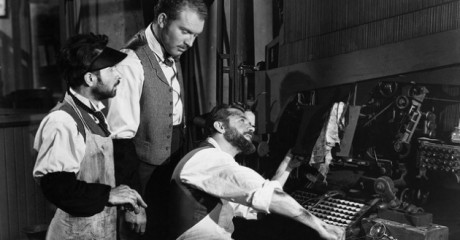
In the gritty, bustling heyday of print news in 1880s New York, a hard-nosed newspaper man (Gene Evans) quits his job at The Star, a prestigious paper run by an unscrupulous editor (Mary Welch), to start his own publication. Made with little more than his own meager resources and industry know-how, the newsman runs The Globe with journalistic integrity while publicizing the arrival of The Statue of Liberty, the building of The Brooklyn Bridge, and fighting off his frequent and often brutal rivals. Once a correspondent himself, "Park Row" is Sam Fuller's tough, romanticized view of the prominence of the newspaper industry, which may hold special significance in this modern era of waning print journalism. The film is compacted though energetic  and highly entertaining, featuring fine performances from a largely unknown cast.

Tuesday, March 6, 2012

Singin' in the Rain

As silent movie megastar Don Lockwood (Gene Kelly) and his onscreen costar Lina Lamont (Jean Hagen), whom he secretly loathes, walk the red carpet for their latest premier, the rumbling of the talking pictures is just a shout away. Don and his best friend/piano player Cosmo (Donald O'Connor), who have a background as song and dance men, will be well suited to the new format, but screechy voiced Lina will probably not survive the transition. Now, after falling for a perky chorus girl with the voice of an angel (Debbie Reynolds), all Don has to do is figure out how to save his latest project with Lina, "The Dueling Cavalier". "Singin' in the Rain" is a sheer delight, and one of the all-time great musicals, if not movies of all time. Codirected by Stanley Donen with Gene Kelly, the film is a mash-up of a story by Adolph Green and Betty Comden and the songbook of classics works by Arthur Freed and Nacio Herb Brown. The result is a free wheeling, toe tapping joy enhanced by the engaging performances of its casts. Gene Kelly shines both as an actor and in his song and dance acts, Debbie Reynolds is delightful as Kathy the chorus girl, Jean Hagen is hilarious as the heavy, and Donald O'Connor is excellent, particularly in the "Make 'Em Laugh" dance number where he performs a seemingly impossible set. "Singin' in the Rain" is a celebration of the movies done in jovial fashion that is a wonder every time it is revisited. 

Tuesday, February 28, 2012

Pat and Mike

A female phys-ed instructor (Katharine Hepburn) and all around athlete sporadically enters a golf tournament which she seems surprisingly poised to win. Bribed by an unethical sports manager (Spencer Tracy) to lose, she refuses but loses anyway thanks to her flustered state due to the presence of her unnerving fiance (William Ching). Soon, she is signed by the manager and embarks on a whirlwind multisport national tour while quickly falling in love with him. "Pat and Mike" is another excellent entry from Tracy and Hepburn, which reunites them with director George Cukor and wedded writing team Ruth Gordon and Garson Kanin. Hepburn's spunk is quite infectious and plays very nicely to Tracy's hard nosed New York City type, especially in a riotous scene where she muscles some imposing thugs (one of whom is played by a young Charles Bronson) trying to collect a debt from her manager. "Pat and Mike" is a light but exceedingly entertaining picture that once more demonstrates the remarkable chemistry between its two stars and their longtime collaborators.

Monday, January 23, 2012

Ikiru

An elderly bureaucrat who has given up on life long ago receives a terminal stomach cancer diagnosis. Despairing his wasted life, lack of friends, and his relationship with his estranged son, the man opts to spend every penny in a night of drunken revelry. Coming to his senses, he takes consolation in the company of a younger coworker who, in turn, inspires him to take up a small yet courageous act of public goodwill. "Ikiru" is a film of truth and great beauty from legendary Japanese director Akira Kurosawa. A change of pace from his equally insightful Samurai pictures, "Ikiru" is a frank and existential look at one's man life, told artistically and atypically. Takashi Shimura is excellent and incredibly effective as the protagonist, and as his character's life begins to find purpose in the building of a playground against all the nonsensical and bureaucratic red tape, it culminates in one of the most beautifully realized endings in the history of the cinema. "Ikiru" is a sad, moving, and ultimately life affirming rumination on the banality of bureaucracy and the catharsis of charity.

Tuesday, January 3, 2012

Limelight

In 1914 London, a drunken and forgotten comedian stumbles his way into his apartment when he begins to smell gas emanating from one of the flats. Breaking the door down, he rescues a suicidal dancer and afterwards begins to nurse her back to health. Raising her spirits and devoting himself to her, the clown begins a revival in order to raise money for her revue, but fails miserably leading to a role reversal with the dancer championing his spirits. All results in a grand finale with the two artists performing in a grand production. "Limelight" is Charlie Chaplin's tribute to his life's work. While overindulgent and overly sentimental, the film is deeply moving and stylistically superior. Hearing Chaplin speak, which he had done before on film, is a great surprise as his voice is elegant, well-spoken, and not at all a letdown compared to his silent tramp. His performance is wonderful as well, incorporating many of his silent gags into the spoken role. Clare Bloom is really fine as well, even though her character is overly mawkish. While the best parts, in my opinion, occur in the smaller moments in Chaplin's flat with Bloom, the culmination song and dance routine between Charlie and fellow silent great Buster Keaton is the highlight of the movie. "Limelight" is a deservedly indulgent self-tribute by and to the greatest clown of the cinema.

Thursday, June 30, 2011

The Narrow Margin

Two police officers are escorting an icy mob bosses' widow by train from Chicago to L.A. to testify in a  racketeering trial. When they arrive to pick her up, one of the men is gunned down. Now it is up to one man to guard the uncooperative and unappreciative witness on the locomotive while dealing with assassins, bribes, a mysterious woman riding the train with her son, and other possible threats. The Narrow Margin is a fabulous motion picture and is often cited as one of the best B-pictures of all time. Directed by Richard Fleischer and starring Charles McGraw, it is an exciting motion picture that ratchets up the tension with great plotting and wonderful direction. There's not a slack moment or false note in this fine noirish movie.

Saturday, September 11, 2010

The Bad and the Beautiful

The Bad and the Beautiful tells the story of a heartless producer, and although not quite in the same league as the other 1950s Hollywood scandal and corruption classic Sunset Boulevard, it is a powerful condemnation on its own. The story of powerful producer Jonathon Shields (Kirk Douglas in a commanding performance) begins when three of his former colleagues are called in by producer Walter Pidgeon to work on Shield’s latest project. All three hold the utmost contempt for him and the bulk of the film will consist of three segments, where each will tell the story as to why they refuse to work with the once great filmmaker. Barry Sullivan plays an aspiring director who teamed up with Shields and broke into the industry only to be stabbed in the back. Lana Turner plays the alcoholic bit player who is given a big break by Shields, only to be misled. Dick Powell plays a writer whom Shields lures to Hollywood , who will soon face a tragedy involving his star struck wife (Gloria Grahame in an Oscar winning performance). The Bad and The Beautiful drags at parts, but each segment is punctuated with segments of scenes and intense acting. The way the story is told is unique and engaging though, and provides a fine prism through which to view a corrupt Golden Age of Hollywood.
***