Showing posts with label 1969. Show all posts

Saturday, April 22, 2017

Anne of the Thousand Days

With Katharine of Aragon past her child bearing years and failing to produce a male heir, Henry VIII (Richard Burton) sets his sights on the beautiful young Anne Boleyn who successfully manipulates him to seek divorce, thus breaking with the Catholic Church while warring with Spain. She proves no match, however, to his uncontrollable jealousy and madness and the wiles of his brilliant, unscrupulous adviser Thomas Cromwell (John Colicos) when the marriage proves just as fruitless as the first. Sometimes intriguing but mostly forgettable entry of the oft-filmed story which has had a resurgence lately (i'd recommend Wolf Hall for a better treatment) and pales in comparison to other castle intrigues of the era (Lion in Winter, A Man for All Seasons). Burton is strong but probably miscast and Bujold makes a lifeless Boleyn.
** 1/2 out of ****

Wednesday, March 29, 2017

Don't Drink the Water (1969 and 1994)

While on a European vacation during the height of the Cold War, a grouchy New Jersey caterer (originally starring Jackie Gleason, then Woody Allen), his overbearing wife (Estelle Parsons, Julie Kavner), and daughter are trapped behind the Iron Curtain, accused of espionage, and forced to hideout in a U.S. embassy run by a feckless ambassador (Ted Bessell, Michael J. Fox) while targeted by an overzealous party member. Allen's play, first filmed in 1969, is hilarious fun with Gleason's mugging, Parson's ditziness, and one of the funniest collections of Woody's one-liners until it peters out towards the end. Unsatisfied with the results, Allen directed and starred in a made for TV remake which contained unnecessary rewrites and a lackluster cast which doesn't match up to the original.
1969 version: *** out of ****
1994 version: ** out of ****

Tuesday, January 31, 2017

Army of Shadows

As German troops march on the Champs-Elysee (in one of the great movie openings), members of the French Resistance plot, traffic in contraband, bear torture, face death, escape confinement, and smoke out informants from their own cells. Jean-Pierre Melville's tense, gripping and personal Army of Shadows is a thriller told with meaning and purpose with no delusions of happy endings, false hope, and phony heroism, dealing instead with self-sacrifice in the face of an apparent losing battle. The film is, however, almost too murky and atmospheric and with a thriller of this sort, despite its realistic intentions, i don't think it would have hurt to have been plotted a little more deeply.
*** 1/2 out of ****

Monday, December 19, 2016

Selected Shorts by Werner Herzog

Just as he has been drawn to epic, quixotic projects, in his extended career Werner Herzog has also favored short form storytelling, the results of which have been no less outlandishly idiosyncratic. Here is a random sampling of these films, all of which can be found readily online or as part of DVD extras:

Precautions Against Fanatics, 1969
One of Herzog's first film attempts is a very short (and very unfunny) look at people involved in horse training.
**

The Great Ecstasy of Woodcarver Steiner, 1974
Presents the story of a ski jumper who was so veritable that he began to flagrantly and dangerously overshoot the course. Plays like an episode Wide World of Sports, but not without great footage and central Herzogian themes.
***
Ballad of the Little Soldier, 1984
Intriguing footage of child soldiers from an impoverished Nicuraguan village preparing for combat against the Sandinistas.
*** 1/2

The Dark Glow of the Mountains, 1985
The director and his German speaking subjects are disappointingly dubbed over by an American narrator in this no less compelling documentary of a pair of mountain climbers who discuss their trade and the perils involved.
***

Thursday, September 15, 2016

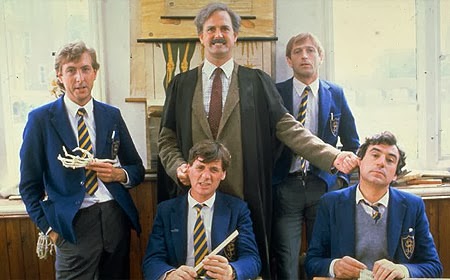
Flying Circus and the Python Films

It is difficult to describe the appeal of Monty Python, the irreverent and game changing British comedic troupe, when their irreverent material is as often inane and borderline unwatchable as it is uproarious. Nevertheless the appeal of the group, which consists of members John Cleese, Graham Chapman, Michael Palin, Terry Jones, Eric Idle, and Terry Gilliam and began on the stage and continued on through television and film, is undeniable and their influence on comedy is immeasurable. Here is a brief rundown of their work:

Flying Circus ran on the BBC between 1969 and 1974 with a feature film titled with the group's favorite segue And Now for Something Completely Different sandwiched midway in its run which took the odd approach of refilming some of their greatest hits without of the presence of a studio audience, the result of which is strangely compelling. The series has many regrettable sketches and running gags, and I feel I should keep my opinion on Gilliam's animations to myself in fear of being shunned, but it is absolutely worth suffering the dreck to get to their best and most outrageous routines (or you could just watch them on YouTube---my favorite bit is Palin's bumbling Spanish Inquisitor).

The gang followed up the series with Monty Python and the Holy Grail, perhaps the most widely seen of their features and what I'd personally consider the best of the lot. This silly take on the Arthurian legend has many indelibly hysterical moments and only starts to come apart at the seams towards the very end.

The controversy generated by Life of Brian, which tells the tale of the child born a manger over from Christ, catapulted the Pythons to international superstardom, but the film offers easy and obvious satire, with belabored gags, and laughs that are few and far between (though those few present are hearty). Gilliam's direction does achieve great period look (though his influence beyond that is distracting) and Palin's Pontius Pilate is unforgettable. Casting Chapman in the lead serves as a great disappointment considering what is lost in the supporting roles.

Time Bandits is not officially a Python movie but it was directed by Gilliam who cowrote the script with Palin and features cameos from both Palin and Cleese. The fantastical and occasionally creepy children's story deals with a band of dwarves in possession of a time travel map who take a neglected youth on their marauding journey through history. The film again falls apart towards the end but the actors are likable and the proceedings are worthwhile for the hilarious cameos, which also include Ralph Richardson and Sean Connery. 

Next up was Live at the Hollywood Bowl, a live show converted to film and released theatrically which consists of old sketches and new that comes off quite well leaving you pondering if their material isn't best suited for the stage. 

Meaning of Life, which takes a surreal look into each of life's stages, is a sporadically funny feature which is hurt by dark and atypically heavy dosages of cynicism and vulgarity. The short film that opens the movie is a highlight and the "Every Sperm is Sacred" number is priceless.

In 2014, the Pythons returned for a live farewell show of sorts, Monty Python Live (Mostly), which featured an array of live performances, clips old and new, and a musical revue, all with the participation of the remaining and surprisingly capable troupe members, save Graham Chapman who is roundly toasted during the performance.

Saturday, August 20, 2016

Kes

Born in an impoverished British working class community, browbeaten by his classmates, teachers, and older brother and destined for the coal mines, a young boy finds comfort in his pet falcon which he rescues from the forest as he studiously teaches himself the art of falconry.  From Barry Hines' novel A Kestrel for a Knave, Ken Loach's early career triumph of the human spirit is a lovely, little heartbreaking film. with an innate performance from David Bradley, maybe the best youth performance ever committed to film, and insightful sociopolitical commentary not shoved in your face which could serve as a lesson to modern civic minded filmmakers. Funny, moving, beautifully done. I loved this movie!
**** out of ****

Sunday, July 24, 2016

Easy Rider

After successfully transacting a coke deal, two free spirited dropouts (Peter Fonda, Dennis Hopper) cruise from L.A. to New Orleans on their choppers, taking in the counterculture (and a lot of dope and acid), while bearing the hostility and aggression of mainstream society. Easy Rider spearheaded the independent, auteur driven film movement of the 1970s (while also inspiring an onslaught of unworthy knockoffs) and Fonda and Hopper's film, which they coauthored with Terry Southern, is an incredibly photographed and edited, offbeat, rambling outdated snapshot of its time. Hopper's performance becomes tiresome after awhile seeming to have lent itself to hippie cliches, but Fonda is tremendous, and Jack Nicholson is unforgettable in one of the great cinematic breakthroughs playing a drunken philosophical attorney the duo meets along the way.
*** 1/2 out of ****

Monday, July 18, 2016

Medium Cool

A Chicago photographer (Robert Forster) is zoned in on his work to the point where he has little or no empathy for his subjects or what's going on around him. Soon, he finds himself romancing a single mother (Verna Bloom) new to the city and caught up in the chaos surrounding the 1968 Democratic National Convention. The great cinematographer and recently deceased Haskell Wexler's Medium Cool is an offbeat, experimental, and political film that doesn't follow any narrative pattern and incorporates highly charged, historically significant live documentary footage. Forster and Bloom are appealing.
*** 1/2 out of ****

Friday, January 8, 2016

On Her Majesty's Secret Service

Bond globe trots on the sly to determine the true reason behind Blofeld's involvement in a seemingly above board business venture (do these movies really need plot descriptions?). In his only outing as 007, George Lazenby leaves a lot to be desired in a performance that seems to be a Connery sendup and little more. Diana Rigg is a weak Bond girl and Telly Savalas makes an effective villain. Much silliness ensues intermingled with some impressive chase sequences.
** 1/2 out of ****

Tuesday, December 1, 2015

Take the Money and Run

A profile of the life of Virgil Starkwell (Woody Allen), a career criminal/bank robber so incompetent that tellers can't even read his his handwriting instructing to pass over the loot. With interviews from his parents, teachers, associates, and young bride, this study looks into what turned Virgil wrong and why on earth he never pursued another line. Following the humorous What's Up, Tiger Lily, which is mostly just an overdubbed and edited Japanese movie, Take the Money an Run, an early mockumentary entry, is technically the first directing feature for Woody Allen and is a muddled hodgepodge featuring alternately hilarious and unfunny gags.
** 1/2 out of ****

Monday, September 7, 2015

Eric Rohmer's Six Moral Tales

When the New Wave landed on shores of France and rocked world cinema, Eric Rohmer quietly but intently observed the work of his contemporaries from the Cahiers du Cinema offices where he worked as an editor. There he plotted a series of ostensibly related films, all dealing with a middle class protagonist's responding to a temptress, which were filmed over the period of a decade, and were grouped together as the Six Moral Tales.

The Bakery Girl of Monceau (1963) is a short two reeler, simple, offbeat, talky, icy, and beautifully shot, effectively setting the tone for the entire series. Featuring future directors Barbet Schroeder in the lead and Bernard Taverneier as narrator, it tells the story of a young attorney who makes increasingly frequent visits to a neighborhood confectionery to encounter the title clerk.
*** 1/2 out of ****
Suzanne's Career (1963) followed, and is an intelligent and incredibly prescient, here detailing a woman coming in between the friendship of two friends, one a skirt chaser the other a bashful introvert.
*** 1/2 out of ****
La Collectionneuse (1967) was the first feature film realeased in the series but was actually intended as the fourth tale, bumped up on the shooting schedule when Rohmer failed to achieve weather effects and postponed My Night with Maud. It tells an idyllically set and beautifully shot story of cruel intellectualism about two friends vacationing on the Riveria who find their vacation impeded by a promiscuous guest. 
*** 1/2 out of ****
My Night with Maud (1969) may be the best known of the lot and is my candidate for the finest realization in an unrivaled program. An uptight intellectual bumps into an old friend around the holidays, is invited for dinner to a recently divorced knock-out's chateu, where the two wind up alone, discussing love and philosophy before getting down to business. Perceptive, crisply filmed, and wonderfully acted
*** 1/2 out of ****
Claire's Knee (1970) involves a diplomat on vacation and awaiting marriage who, while visiting with an ex-lover, becomes obsessed with the idea of caressing his landlady's stepdaughter's knee. 
This fifth entry is somewhat creepy, but again retains the film values of its predecessors and remains very watchable
*** 1/2 out ****
Chloe in the Afternoon (1972) concluded the series and, true to form, is involving, low key, and dialogue heavy. Its plot revolves around a happily married Parisian lawyer who hopelessly pursues a bohemian seductress.
*** 1/2 out of ****

Wednesday, March 11, 2015

Downhill Racer

A cold, insensitive, self-minded skier (Robert Redford) travels to Switzerland and joins the American squad and their hard-edged coach (Gene Hackman) as an injury replacement. Soon, through skill and dubious, unscrupulous methods, he glides his way to Olympic glory. Michael Ritchie's Downhill Racer is a relevant as ever treatise on bloodthirsty competition which strives for verite like realism (I liked how Hackman would flub a word or two during a heated argument or a hand would graze the camera lens during a crash sequence) but keeps its story in the background somewhat. Redford's role is a significant departure for his typically moralistic leading roles and his character's quiet, unabashed narcissism is quite jolting. Hackman is excellent is a supporting role and the film also boasts incredible photography and ski sequences which literally caused my heart to skip a beat during every wipeout.
*** 1/2 out of ****

Saturday, September 13, 2014

Goodbye, Mr. Chips

A dull teacher (Peter O'Toole) finds unexpected love with a chorus girl (Petula Clark) while on vacation in the Greek isles and returns with a new attitude to his all boys British preparatory school where he was once the scourge of his students. Goodbye, Mr. Chips is the second screen adaptation of James Hilton's novel, and although O'Toole is superb and Clark is sweet, this simple story is so overblown and compounded by a needless and saccharine musical treatment.
** 1/2 out of ****

Saturday, July 13, 2013

The Wild Bunch

At the tail end of a nearly faded West, Pike and the few remaining members of his band of outlaws (William Holden and Ernest Borgnine, Ben Johnson, Warren Oates, and Jaime Sanchez) head south to Mexican territory following a botched robbery and being pursued by a posse led by an ex-gang member (Robert Ryan). There they become entangled with a powerful general and a railroad magnate, are forced to confront their values, and continue on to their impending, bloody destiny. Sam Peckinpah's The Wild Bunch created a whirlwind of controversy when it was released in 1969. Viewing it today, although the violence now seems commonplace, it still creates a shock, both because of how well it is handled through quick cutting and slow motion techniques and from the actual message behind it. It features an excellent veteran cast of distinct, worn faces with Ryan standing out with an excellent performance.

Monday, April 22, 2013

The Italian Job

A recently release ex-con (Michael Caine) gets right back in the thick of things, and assembles a team to pull off the complex job of relieving the Turin mafia of a large amount of gold bullion, all as me means of revenge following the death of his former business partner. "The Italian Job" is a cheesy, Swingin' 60s movie, unworthy of Caine's talents (as has been the case for a lot of projects he's chosen) and filled with unmemorable characterizations. It is worth seeing for the breathtaking European scenery, riveting chase sequences, and the hair-raising, atypical conclusion. Also, the British playwright and director Noel Coward appears in his last film, and is amusing as Caine's fence.

Friday, January 4, 2013

Get Yer Ya Ya's Out

Recorded in late 1969 as part of the Let It Bleed tour, The Rolling Stones' Get Yer Ya Ya's Out has gone on to be heralded as one of the great live albums. Filmed by the Maysles brothers along with material that would become the pivotal documentary "Gimme Shelter", this short film was assembled by Albert Maysles (David died in 1987), Brad Kaplan, and Ian Markiewicz for the 40th year re-release. Though not even thirty minutes long, it features rare and brilliant footage of the Stones performing at Madison Square Garden, some post concert album editing, the cover shoot with a mule on a blocked off NYC highway bridge, and some offstage appearances from Jerry Garcia and Jimi Hendrix.

Saturday, December 1, 2012

Age of Consent

An aging artist (James Mason), feeling uninspired in New York City, returns to his native country for inspiration, seeking solace on a gorgeous, supposedly deserted isle off The Great Barrier Reef. To his surprise, he meets a beautiful, teen aged island inhabitant (Helen Mirren) who quickly becomes his muse, which leads to cases of blackmail and extortion, initiated by an old chum (Jack MacGowran) and the girl's wicked, boozy grandmother (Neva Carr-Glynn). "Age of Consent" was the last film in the remarkable career of the innovative director Michael Powell, and was made after a period of ostracism following the release of his controversial, ahead of its time "Peeping Tom" in 1960. Based on an autobiographical book by the Australian artist Norman Lindsay, it features a late career performance from Mason and a very early one from Mirren (who is incredibly sexy in the picture), both of which are excellent, and the central relationship between the two is surprisingly sweet. This is also a great looking picture, containing many of Powell's expected flourishes and like most of his films, many which were made with Emeric Pressburger, it ends well. The only flaw are the supporting performances from MacGowran and Carr-Glynn which are highly obnoxious and counter the tone of the film.

Monday, May 23, 2011

True Grit

In 1969 John Wayne won his sole Acadamy Award for portraying Rooster Cogburn, a slovenly one-eyed U.S. Marshall in the enormously sucessful True Grit which spawned a sequel featuring Katharine Hepburn as well as a largely successful recent retread by The Coen Brothers. I don't wish to compare both films here except for saying that although Jeff Bridges portrayal was wonderful and probably more precise as to what a slovenly U.S. Marshall should be, the role belongs to The Duke who originally established it with his massive presence and charsima. The story revolves around Mattie Ross (Kim Darby) whose father is murdered in cold blood. She hires Cogburn, a man she believes possesses grit, to track the killer across dangerous country where they are in turn joined by La Boeuf (Glen Campbell), a Texas Ranger seeking a bounty on the same man. True Grit was directed by Henry Hathaway and seems to be an inclusive adaptation of the Charles Portis novel. It is filmed in glorious technicolor, while containing hokey elements associated with like films of the time. Stars Darby and Campbell are both weak as actors but effectual in their roles. It is also interesting to see Robert Duvall and Dennis Hopper in early roles. What makes the film special is the rousing final 30 minutes of the picture and Wayne's unforgettable commanding performance.

Saturday, August 28, 2010

The Prime of Miss Jean Brodie

The Prime of Miss Jean Brodie is refreshing in that it is the story of an educator who does not act as an inspiration for her students, but may in fact be harming them. Starring Maggie Smith in her Academy Award winning role, she plays Jean Brodie a teacher at a British girl’s school in the 1930s. In addition to the usual reading, writing, and arithmetic, Miss Brodie teaches her students about the great fascist leaders Franco and Mussolini while detailing her personal life to her young students. As she catches the eye of one faculty member and longs for the affections of another, her class will be mislead, two particular students in truly disturbing ways. Though I’ve not read much about it, this must have been a daring film for its time, and is made all the more interesting by Smith’s fully realized portrayal of a complex character.
***

Sunday, April 18, 2010

Butch Cassidy and the Sundance Kid

The Westerns always took themselves so seriously until Butch and Sundance came riding in and lightened things up. Butch Cassidy and the Sundance Kid is pure entertainment and it is a delight to watch Paul Newman and Robert Redford up on the screen. There are many memorable moments in George Roy Hill's film from the train roberries, to the bicycle ride set to Burt Bacharach's "Raindrops Keep Fallin' On My Head", up until the memorable finale. It is also beautifully filmed by Conrad L. Hall and wonderfully written by William Goldman, both Oscar winners. This is not a perfect film though. The second half is not as fun as the first, and there are several lulls, mainly during some overly extended montages. Still, this is a classic film, great fun, and the movie that brought a sense of humor to the movies.
***1/2