For most men, many of our found memories include involvement with childhood athletics, particularly the thrill of the sport and the purity of the game. The 30 for 30 entry Little Big Men, is about the grown team members of the 1980 Little League World Champion Team from Kirkland, Washington reminiscing on their glory days and the exploitation and loss of innocence that followed their great underdog victory. In the decade prior to that victory, Taiwan had dominated the Little League World Series, winning every season except for a loss one year to Japan, and an American victory another year when foreign participation wasn’t allowed. When Kirkland surprised everyone in their region and journey to South Williamsport, Pennsylvania for the grand tournament, no one expected much. Yet, they prevailed and the heart of the story details what followed. One of the lesser known subjects in this series, it proves to be one of the elite entries as the positive and negative aspects of Little League Sports are recounted with genuine emotion by a group of men who experienced the extreme of both.
***1/2
A blog dealing with either the joy of cinema or the agony of cinema--nothing in between.
Thursday, September 9, 2010
Barfly
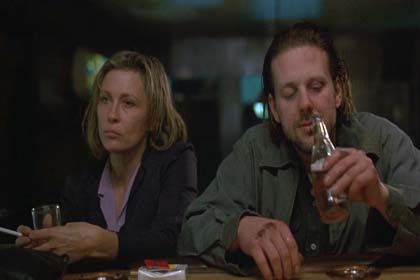
Some people wallow in poverty, misery, and alcoholism. Henry Chianski thrives in them. Fighting shallow bartendeners for drinks in the local dives and jotting down an occasional inspired thought in his cramped, squalid apartment, Henry is curiously amused and seemingly content with his situation and condition. He only expresses discontent when he is taken to the nice side of town and tempted with opulence ("no one who could ever write worth a damn ever 'wrote in peace'"). Barfly tells the story of a couple days in Henry's life, and stars Mickey Rourke who takes a risk and plays him as a hunchbracked Brandolike goon who stomps around and overdelivers his lines. The result is a likable character that I found amusing. Faye Dunaway also delivers a fine performance as a boozy woman that takes him in. Written by Charles Bukowski (Chianski is his alter-ego, also played by Matt Dillion in Factotum), the dialogue is brilliant at points and although the film rambles, it is entirely likable throughout.
***
***
Monday, September 6, 2010
Angel Heart
Angel Heart starts out as a 1950s noirish detective story on the tough streets of the Bronx and quickly turns into a gothic nightmare, enwashed in blood and satanic rituals in the swamps of Louisiana. Starring Mickey Rourke as a burnt out P.I. given a mysterious job from a mysterious client (Robert De Niro in a small, juicy role), Rourke soon finds himself way over his head in the search for a missing person who owes a debt to De Niro. Directed and written for the screen by Alan Parker, the film functions as an example of success for style over substance. The final twist can be figured out through many clues throughout the picture, but the success of the film lies in the performances, the cinematography, and the sheer brashness of the visuals.
***
***
Wednesday, September 1, 2010
The American
Jack (or maybe its Edward) is an assassin who lives life as reclusively as possible. Most people know very little about him and what he tells them about himself is usually lies. The woman he's currently with in a rural Swedish town clearly doesn't know who he is. After having to relocate to an Italian villa, he tells a local priest that he isn't good with machines, we soon learn that that is far from the truth. Later he visits a brothel and tells one of the girls that he is there to get pleasure, not give it, but we already know that that's a lie as well. George Clooney kicks off the fall season with a film that contains familiar elements that will probably be entirely unexpected to most viewers. The American is an exquisitely shot and languidly placed film where we experience entirely what the protagonist experiences. We see what he sees, get in his head, and soon his own paranoia soon becomes ours. Not everything is explained clearly because maybe he doesn't understand their repercussions as well. Clooney shows restraint, yet unexpectedly generates powerful emotions in key scenes. He is our premier film star, and continues to chose the very best projects. The American is a captivating film and by the time he starts running up that winding staircase we have confirmed that we are watching one of the best films of the year.
****
****
Monday, August 30, 2010
The Day the Earth Stood Still
The Day the Earth Stood Still is the prototypical science fiction of the 1950s, containing all the elements, good and bad, that populated the genre during that decade. It starts with the landing of a spacecraft in Washington, D.C. which captivates the whole world. As a spaceman and a robot emerge, a misunderstanding leads to the former’s hospitalization and his subsequent escape from custody as he tries to put together a meeting with the world’s leaders to deliver his message he traveled so long to convey. Made as a warning during the early Cold War years, the film is nicely handled by directing great Robert Wise. Corny elements involving aliens blend with tense images to make a great film-going experience. It also contains the most famous alien phrase/safe word: Klaatu barada nikto.
***1/2
Sunday, August 29, 2010
All That Jazz
To begin with, All that Jazz, the biographical film of Bob Fosse, is a frantic mess. This is appropriate however, since Fosse’s own life, especially during the time the film purportedly portrayed, was a frantic mess. Directed by the great choreographer and director himself, and starring Roy Scheider in an against type casting choice, the film follows Joe Gideon, a Fosse pseudonym, as he directs a Broadway play and edits an overbudgeted film about a stand up comic. He tries to deal with his girlfriend, ex-wife, and daughter, while bearing his soul to an angel in white (Jessica Lange) and consuming as many uppers as possible as he inevitably heads down a path leading towards death. Interspersed with musical numbers and frenetic cutting, All That Jazz is self-indulgent and pretentious, yet curiously engaging. The film probably details the period in his life when he was directing Chicago on Broadway while producing the Dustin Hoffman film Lenny. Though Fosse is not in the same league with other directing greats who have made similar biographical films (Fellini, Woody Allen), All That Jazz serves as a curious and interesting entry.
**1/2
**1/2
Saturday, August 28, 2010
The Prime of Miss Jean Brodie
The Prime of Miss Jean Brodie is refreshing in that it is the story of an educator who does not act as an inspiration for her students, but may in fact be harming them. Starring Maggie Smith in her Academy Award winning role, she plays Jean Brodie a teacher at a British girl’s school in the 1930s. In addition to the usual reading, writing, and arithmetic, Miss Brodie teaches her students about the great fascist leaders Franco and Mussolini while detailing her personal life to her young students. As she catches the eye of one faculty member and longs for the affections of another, her class will be mislead, two particular students in truly disturbing ways. Though I’ve not read much about it, this must have been a daring film for its time, and is made all the more interesting by Smith’s fully realized portrayal of a complex character.
***
City Island
Most often, you can see a really bad movie coming from a mile away and avoid it without your wallet or your precious spare time taking a hit. Occasionally though however a truly awful film, will surreptitiously slither its way onto your screen and attack when you are least suspecting. City Island is a film like that, a film that got fair reviews, that blindsided me by just how truly terrible it really was. It stars Andy Garcia, sporting a horrible NY accent, and the plot is not even worth rehashing. It is a film based on pretensions, unfunny gags, unlikable characters, and outrageous coincidences no one would buy, made all the worst by the fact you can tell the filmmakers and cast think they are making a clever movie.
ZERO STARS
Friday, August 27, 2010
Jordan Rides the Bus
Jordan Rides the Bus tells a fascinating story and is made by a great sports film director, but perhaps takes the wrong approach in telling it. After Michael Jordan lead the Bulls to another championship in 1993, his father was murdered along a seemingly peaceful North Carolina highway. This lead to Jordan’s early retirement from basketball, and his entry into baseball—a move that generated much attention, both positive and negative. The film takes the approach that it was his right and that he was even courageous and self-sacrificing in making such a move, but I think that the film would have worked much better from an objective standpoint. Still it is a great story, and Ron Shelton (Bull Durham, Cobb, White Men Can’t Jump) knows how to piece together a sports film.
***
Thursday, August 26, 2010
Get Low
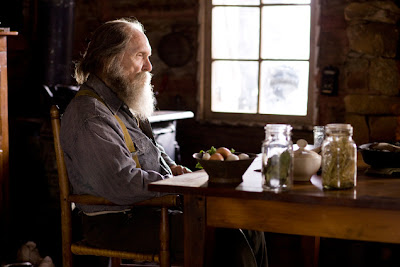
I’m not sure if I’ve ever seen such a beautifully shot film, with strong performances from actors I admire, with such a nauseating, contrived plot that would feel right at home on television. Get Low stars Robert Duvall as a hermit, Bill Murray as an undertaker, Lucas Black as his assistant, and Sissy Spacek as Duvall’s old flame. All four, including the young Black who is a bright spot in the disconcerting young Hollywood talent pool, fill roles they fit comfortably in and always fill those shoes admirably. As far as Duvall, one of our great, underrated, and most consistent of all actors, is the only person imaginable who can make the final revelatory speech moving, even as we acknowledge that he is spewing a bunch of tripe. The ***½ review is admittedly an overrate, but also a prime example of how great acting can save such a shitty ill conceived plot.
***1/2
Wednesday, August 25, 2010
The Baader Meinhof Complex
Though not directly explained in the film, I think the Baader Meinhoff Complex refers to the different takes of RAF gang members Andreas Baader and Ulrike Meinhoff, as well as the notion that the children of the German World War II Generation had to rebel against the actions and politics of their parents, but couldn’t resist the use of extremism is their cause. It tells the story of the left wing Red Army Faction in Germany in the 1970s from the viewpoints of the gang’s leaders (lovers Baader and Gudrun Ensslin, and journalist Meinhof) as well as a police head (played by the great Bruno Ganz) who tries to understand the gang motives. The RAF isn’t The Barrow Gang or The Whole In The Wall Gang, and are portrayed as pathetic terrorists who generate no sympathy from the audience. The film is an intriguing, if overlong and overstuffed film about a group that captivated and terrorized Germany in the 1970s, which is also a subject that many, at least in this country, are unfamiliar with today.
***
***
Tuesday, August 24, 2010
The Karate Kid
The Karate Kid is an underdog story that we identify with even more so because the underdog is not a hopeless cause who makes a 180. Instead he is like many of us—yes beset upon and depressed but at the same kind capable and engaging. The story begins with a cross-country move from New Jersey to LA where the young teenage boy begrudgingly accompanies his mother who has just got a new job. Putting his best foot forward, he makes a new friend then meets a girl, only to incur the wrath of her ex, a bleach blond Karate master. Soon he is the recipient of beatings until he finds out a secret about the maintenance man in his apartment which eventually leads him down a path of friendship, self-defense, and self-respect. The Karate Kid is utterly enjoyable and Ralph Macchio and Pat Morita so natural in their respective roles. It is no surprise that the film was helmed by John D. Avildsen, the same person who helmed Rocky, a similar story with a similar lead character we can identify with. Although we may be familiar with how this journey goes, we are taken in by every second of the ride.
*** 1/2
*** 1/2
Monday, August 23, 2010
Tell No One
Tell No One is a French film, adapted from an American novel, and succeeds as a thriller, mystery, and chase film. Jam packed with plot and characters, with a likable enough lead character, Tell No One will have you forgiving its plot holes and contrivances. Its story involves a pediatrician who lost his wife eight years earlier. Although her murder was pinned on a serial killer, the circumstances surrounding her death were murky, and the police have always suspected the good doctor of foul play. Now, two bodies have turned up near his summer home (also where his wife was killed) and he is again a suspect. Also he has received a mysterious email that has implications that his wife may still be alive and well. The film is handled slickly and the visuals are exciting. Though developments and plot twists may leave you scratching your head, this is still a thriller that delivers.
***
***
Sunday, August 22, 2010
Scott Pilgrim vs. the World
Is it possible for a highly original film to wear out its welcome? Scott Pilgrim vs. the World is a unique film that does just that through multiple endings and overlength, although there are many creative moments interspersed throughout. From a comic book, the film is directed by Edgar Wright, helmer of the beloved British Simon Pegg comedies. Inhabiting a reality that resembles a video game, Scott (Michael Cera) has found the girl of his dreams (Mary Elizabeth Winstead). Now he must get out of his relationship with a high schooler, try to win battle of the bands, and earn his new crush's affection by defeating her 7 Evil Ex's who are trying to control her and destroy him. Although the filmmakers know they have an original and take things too far, I believe this film will be beloved by many in the same way that (500) Days of Summer was last year.
**1/2
**1/2
This Is Spinal Tap
I would describe This is Spinal Tap as more amusing than hilarious, but it still should be recognized as an influential forerunner of the mockumentary, a genre that has been mastered by many of the participants in this film. Here director Rob Reiner, as director Marty DiBergi chronicles Spinal Tap, the world’s loudest band, and their latest tour. The film functions as a rock concert film parody, as the bumbling members of the band are interviewed interspersed with (fake) concert footage and other hijinks. Michael McKeon as David St. Hubbins, Christopher Guest as Nigel Tufnel, and Harry Shearer as Derek Smalls are ideal in their roles as members of the band. The film contains such classic moments as the cause of death for the band’s numerous drummers, the story behind McKeon’s name, and the amp that goes to 11. Despite some slow patches, the film earns its iconic and cult status.
***
***
Saturday, August 21, 2010
A Letter to Three Wives
Joseph L. Mankiewicz was a director who was concerned with the bigger picture. His films often functioned as social commentary on top of entertainment, and his A Letter to Three Wives, which he won Oscars for adapting and directing, is a prime example of his style. Featuring a highly original plot, it introduces to three women and a female narrator. The trio are friends from different social strata-Upper class, Middle to Upper, and Poverty Level and each are semi obsessed with the narrator, whom they claim to be a friend as well. As the three women board a yacht for a getaway, they receive a letter from the narrator who informs them that she has run off with one of their husbands. Each woman then has a flashback which gives them reason to believe that their spouse may be the man in question. The flashbacks also serve as social commentary as each serves as a criticism of the upper class. Kirk Douglas and Paul Douglas (no relation) stand out as two of the spouses. I did find the film intriguing but maybe a little dated and hard to get into at points. Still it is an interesting entry from an important director from the golden days of Hollywood.
***
***
The Killers
The Killers, based on a short story by Ernest Hemingway, opens fantastically with a diner/hostage scenario followed by the murder of the main character. It is followed by a contrived insurance investigation coupled with an effective flashback plot narrative in which we learn what led to the opening events. The film is often mentioned as an epitome of film noir, and that it is, as it contains all the elements that make up the genre such as the dark shadows, troubled hero, femme fatale, etc. It also represents the breakthrough performance of Ava Gardner and the debut of Burt Lancaster, reportedly the studio’s last choice, but an unavoidable one. By that I mean it seems that Lancaster was destined for the movies with his screen presence, physical stature, and dramatic demeanor. It is also worth mentioning that John Huston anonymously contributed to the screen play, and was probably responsible for its hard boiled elements. The Killers represents a classic, though flawed, entry into the original American film genre.
***1/2
Thursday, August 19, 2010
The Killer
Of the films John Woo made before leaving for Hollywood, people usually mention Hard Boiled and The Killer. After recently viewing Hard Boiled and being disappointed, I approached The Killer with skepticism. However, it turned out to be superior to the other Hong Kong based cop/criminal film and actually a worthwhile movie experience. The Killer also stars Chow Yun-Fat as a contract killer, living by a code and trying to get out of the profession, who has just blinded a singer he admires during his latest hit. In order to pay for her corrective surgery, he takes out one last hit but circumstances lead to him being chased by The Triads, a dangerous Chinese gang, and a persistent, young cop who has recently lost his partner in the line of duty. The Killer is over-the-top as all of Woo’s films are but the action scenes are handled with great style here. The cinematography is also fine, containing some fine scenic shots and not just resorting to the sleazy metropolitan shots that Hard Boiled employed. The character development was handled nicely, and although the final shootout goes on longer than it should, The Killer proves to be a worthy cinematic experience.
***
North Face
After watching my second mountain climbing flick in six months, I’m beginning to think that the big screen is no place for flicks about mountain climbing. With Touching the Void, I thought that film was unable to capture the thrill of the climb (I also thought it failed to convey elements of its intriguing survival tale). Now, with North Face, a German expert about a 1936 expedition, it seems as though the filmmakers may agree with me, as they have thrown in more conventional story elements such as a romance and a villain and a politicized plot, all to no avail. It tells the story of two German infantrymen who are expert climbers in their spare time. When the girlfriend/aspiring photo journalist of one of the men informs them that the German government wants someone to climb the unclimbed and extremely dangerous North Face of the Eiger Mountains to instill German pride in the days before the Berlin Olympics, the men seize the challenge (although one is reluctant). They meet up at the mountain with another team and ascend the harrowing mountain, while the girlfriend and her pugnacious boss report from the mountainous resort. The characters are cliché and underdeveloped and there is too much subplot thrown in. Although the film contains beautiful cinematography and this true story does not turn out as one would expect (or maybe it does), the other elements of the film do not come together, and we find ourselves having a hard time caring about the men that took part in this perilous mission.
**
Tuesday, August 17, 2010
I Never Sang for My Father
We’ve all had relationships with people like the father figure in the film: that stubborn old fool, stuck in his ways, who is unwilling to give into anything. The type who doesn’t understand the times, has a particular way of doing everything, and knows what is best for everyone. Most of us have felt like the man’s son-harboring feelings of anger, disdain, and resentment towards the old man while simultaneously feeling responsible to him with the hope that he will someday reciprocate our love. I Never Sang for My Father is a film that understands this family dynamic and the result is a profoundly moving and humanistic film with two wonderful star performances. Gene (Gene Hackman) is a recently widowed professor, just entering his forties, who sees what may be his last opportunity in his life to start anew. He has taken up with a divorced doctor in California and wishes to move out there to remarry. When he makes his weekly visit to his parents, he tells his mother who agrees it to be the right move, but when it comes to notifying his father (Melvyn Douglas) he balks-the old man has already made it clear that such a move would be disastrous (he just didn’t add that the move would be disastrous for himself). Soon, the mother passes on and his moving plans begin to seem like a pipe dream. His father will now need him more than forever and will not give in to any sort of compromise. This situation will now lead to a decision that Gene has been avoiding for his entire life-a decision to leave his father in order to pursue his own life. Released in 1970 with Gilbert Cates directing from an Academy Award nominated script by Robert Anderson who adapted his own play, I Never Sang for My Father is a triumph on several levels. The performances are top notch, but this is really the story of father and son. Gene Hackman, who was 40 years old when the film came out though relatively new to pictures, is perfect at conveying all the emotions his character goes through. Melvyn Douglas, who was at the end of a prolific career, generates the same feelings in us that the Hackman character feels, as we are reminded of that old codger in our own lives. When the two are together alone on the screen (which is often) the rapport is strong and we feel like we are watching a real father-son drama play out in front of us. The directing of the film is also worth mentioning. Stylistic choices were made, and such techniques as narration, montage, close-up are used which brings greater attention to the film. The dialogue, though heightened, seems natural and real. The result is a realistic view of an ultimately sad relationship that most of us can say we relate to.
****
Friday, August 13, 2010
The Bad News Bears
At first glance, The Bad News Bears may seem like a routine sports film but after viewing it is clear that it is more than that. On top of being an intelligent if crude film, it also makes a statement on competitiveness in little league sports. Walter Matthau plays the beer swilling ex-minor leaguer hired to coach the Bears--the worst team in the most competitive California pee-wee league. After initial disastrous results, Coach Buttermaker brings in a few ringers and employs bush league tactics with his players and finds himself in the championship game, only to have his conscience eat at him. Matthau is in fine form in one of his most popular roles, and there are many laughs to be had in addition to much more if you look beyond the surface.
***
Tuesday, August 10, 2010
June 17, 1994
Some events are so huge that we automatically record and remember our locations when we hear about them through the media. I remember where I was when I heard the news of 9/11, the Oklahoma City Bombings, the falling of the Berlin Wall, and yes during the OJ Simpson Bronco chase down an LA freeway on Friday, July 17th, 1994 (I was at a Tribe game gathered around a television monitor, ignoring the then stellar Indians). I knew that I was witnessing a great media event, but I did not realize that it had been the capper to a red letter day in sports history. July 17th, 1994 by Brett Morgen replays the sporting events of that day, while cutting back to that infamous chase. When not revisting the crime scene in Brentwood or watching the Bronco chase, we are shown New Yorkers mobbing the streets in celebration of the Rangers’ Stanley Cup victory while they await game five of the NBA Finals where Patrick Ewing made his last title bid with Knicks (Costas is preoccupied with chase). Also we are shown the last U.S. Open bid of Arnold Palmer which was also sadly overshadowed by the chase. So far, this is the only 30 for 30 episode to not feature talking head commentary and it features mostly archival footage of that day. The filler is older footage of Simpson’s playing days, Arnold Palmer as a young man, and the Rangers failed bids for the Stanley Cup. The result is an extremely satisfying documentary, which captures our feelings of the time.
***1/2
The Eclipse
The Eclipse is an effective ghost story, one that probably would not take with today’s horror crowd due to its lack of blood and guts in addition to its languid pace. Set in a small coastal Irish town, Michael (Ciaran Hinds) is a recently widowed father of two children and volunteers at the local literary festival. Having been experiencing visions of his dead wife and his near dead father-in-law, he meets Lena (Iben Hjejle), author of the supernatural, and begins to ask for her input. Soon they are attracted to one another. Into the mix comes Nicholas (Aidan Quinn), a successful and smug American author who has had a past fling with Lena and is married. He wants to rekindle their relationship while she knows it was a mistake. This triangle will lead down inevitable roads while the supernatural begins to take a hold of Michael’s life. The Eclipse isn’t afraid of taking its time to develop characters and relish in its lush Irish surroundings. Although I found the ghost story effective, I thought that the film was paced too slow for all the elements to blend together entirely. Still, we are left with an effective ghost story and nice tale of a love triangle in small Irish town.
***
Sunday, August 8, 2010
Pulp Fiction
Birth of a Nation. Citizen Kane. Star Wars.
To that list of films that revolutionized the movies I would also add Pulp Fiction, Quentin Tarantino's masterwork from 1994. As the first three films were not so much unique as influential, they changed how movies were made. Pulp Fiction brought independent films to the forefront and inspired countless retreads with its witty, existential, and massive dialogue combined with harsh violence and the tweeking of the plot structure. Aside from what it did for the movies, it is a great movie within itself and one that is just plain fun to watch and contains probably the best performances from John Travolta, Samuel L. Jackson, Uma Thurman, Ving Rhames, and Bruce Willis. The brilliance of the plotting is in making it episodic, so the film actually feels like three short films and therefore the length doesn't become off-putting. Though I haven't seen it in awhile, I was surprised how much of the dialogue and plotting I remembered, and then I thought that it must be because of how carefully constructed the film is by Tarantino. Every shot, every set, every word, and every actor's mannerism is carefully thought through and presented and the result is a film that did no less than shake the world.
****
Saturday, August 7, 2010
The Two Escobars

The Two Escobars follows the stories of Colombian soccer player Andres Escobar and Colombian drug lord Pablo Escobar, no relation. In the late 80s and early 90s Colombia was among the most violent places to live and a country that contained one of the most exiting soccer teams around. These facts were partially the result of men like Pablo Escobar, whose drug trades created violence in the streets and who also needed ways to launder their funds. An easy way to do this was through purchasing a soccer team and claim the excess funds in player trades. This also allowed soccer teams to keep their best players and acquire new ones, allowing their teams to flourish. Andres Escobar was a star on one of these teams, a man unlike the other men. He served as a role model and did not like what he saw in his country. Both Andres and Pablo, although the latter was a notorious criminal and created many problems, wanted to see changes in Colombia, strived to make a difference, and both met tragic ends--which devastated the country and made them move towards change. The Two Escobars, Jeff and Michael Zimbalist's entry into the 30 for 30 series is intriguing, if not a bit overlong. I did wonder if it wasn't a stretch to draw comparisons between the two Escobars, and I do not necessarily agree with the way the film makes Pablo Escobar into a national hero.
***
Subscribe to:
Posts (Atom)