A blog dealing with either the joy of cinema or the agony of cinema--nothing in between.
Thursday, July 21, 2011
Destry Rides Again
In the lawless town of Bottleneck, the sheriff is murdered by a land baron when he tries to correct a rigged card game. When the baron along with the crooked judge appoint the town drunk as the new sheriff, things don't play out just as they planned. The town drunk knows the score, gets his act together, and deputizes Tom Destry, the son of the great lawman he once worked under. However, Destry is not what he expected, and is a peaceful type who doesn't believe in the use of firearms. Soon though, the new deputy wins over the faith of the town and heart of a fiery dancer as he sets his sights on the evil land baron. Directed by George Marshall, Destry Rides Again is magnificent entertainment. It is a send up of the Western genre, with all the characters painted in broad strokes. Released in the same year as Mr. Smith Goes to Washington, Jimmy Stewart gives another endearing performance again portraying a fish out of water type. Marlene Dietrich is wonderfully scandalous in a role that had to be the inspiration for Madeline Kahn's Lili Von Shtupp in Blazing Saddles. Also Charles Winninger is a hoot as the town drunk/sheriff. Destry Rides Again is wonderful and hilarious entertainment that simultaneously manages to mock the Western and fit comfortably in its boots.
The New World
As Captain John Smith (Colin Farrell) arrives in Jamestown in chains in 1607 and is pardoned for his mutinous ways, he is sent on a mission by Captain Newport (Christopher Plummer) to trade with the local tribes. There he has an extended stay as he learns the ways of the native people and falls in love with Pocahontas (Q'orianka Kilcher), the beautiful and beloved daughter of the mighty Chief Powhatan (August Schellenberg). When he returns to the settlement, his pacifistic nature upsets the settlers who begin to engage the natives in war. Smith continues his love affair with Pocahontas until he is sent on an exploratory mission. At this point, she is brought to live in the settlement and eventually marries John Rolfe (Christian Bale), an admirable plantation owner. The New World was Terrence Malick's fourth film since his career began some 33 years prior and contains all the beauty and wonder we have come to expect from his films. Shot on location in Virginia, The New World almost casts a spell with its stunning imagery and trademark Malick laconic narration. The film also contains a spectacular and should have been breakthrough performance from Kilcher as the intelligent and playful Pocahontas. Although the film is typically light on narrative, Malick once again crafts such a hypnotically spellbinding wonder that makes it difficult to harp on its shortcomings.
Wednesday, July 20, 2011
Oceans
Following Earth, Oceans is the second feature released in the Disneynature series. Through the use of beautiful photography which has become the standard in nature documentaries lately, director Jacques Cluzaud and Jacques Perrin magnificently capture the wonders of the ocean including but not limited to coral reefs, great white sharks, dolphins, crabs, octopus, and blue whales. Wisely, the film has limited narration as I believe the filmmakers realized that the real show is the visuals and excessive narration only detracts from that. Pierce Brosnan makes a fine narrator, not calling too much attention to himself, but the ramblings he is given to read are all over the place and too preachy regarding ocean activism and preservation. Still the beauty of sea life photography truly is breathtaking (I caught myself talking out loud in amazement at several instances). The film makes much about how little is known about our oceans and they are right. Going into this I thought it would be a boring excursion, but I was quickly disproven after witnessing the majestic images on display in this film.
Saturday, July 16, 2011
James Cagney: Top of the World
James Cagney was a vibrant screen presence and one of the top stars in the Golden Age of Hollywood. Known mostly for his roles as a gangster in films like The Public Enemy and White Heat he was also a wonderful dancer from his early days in Vaudeville, which he demonstrated in his Oscar winning turn in Yankee Doodle Dandy. As tough in real life as on screen, yet kind and gentlehearted, he was a family man who saw acting as a way to pay the bills and sought a more simple life. He fought the studios, founded the Screen Actors Guild, and contributed to worker's rights. James Cagney: Top of the World is a tribute to his life and work by family members, coworkers, and friends. Hosted by Michael J. Fox, it is not the finest written documentary with Fox uttering phrases that sound as if they were written by one of Cagney's characters (Now Cagney was never the type to take nothin' from nobody see). Still, it is a pleasure to go through clips of Jimmy's career, who probably had the most screen presence of any actor ever.
Stagecoach
In a small Arizona town, the sheriff, a sickly pregnant woman, a nervous preacher, an embezzling banker, a drunken doctor, a beautiful whore, a notorious gambler, and the gregarious driver board a stagecoach to catch a ride to a nearby settlement, despite warnings that Geronimo has been encouraging Apache attacks. On their way they pick up a strapping young outlaw named The Ringo Kid and ward off Indian attacks while they get to know each other. Blending humor, drama, romance, and adventure, director John Ford took the Grand Hotel formula, applied it to the Western, and set the bar for what would be one of the most sturdy genres for the next thirty years. Stagecoach is also the film that made John Wayne a star, and his entrance as The Ringo Kid with the quick cut and then closeup is one of the most famous entrances in motion picture history. From top to bottom, Stagecoach is a downright entertaining film replete with laughs and exciting action sequences. The extended Apache attack sequence is a wonder for its time (any time for that matter), and as The Duke climbs on the roof of the coach to pick off charging Indians, shoots one of them off the carriage's horses, then jumps onto them to take the reins, we sit back and regard in amazement. Stagecoach launched the career of John Wayne as well as the Western, the two of which may be one in the same. On top of being important and influential, it is simply a rousing all encompassing entertainment.
Friday, July 15, 2011
John Ford/John Wayne: The Filmmaker and the Legend
Director John Ford and actor John Wayne were two titans of the film industry and their complicated partnership led to a rich body of work that encompassed much of who we are as Americans. Ford was an up and coming director in the 1920s when he discovered a striking B-movie actor named Marion Morrison, whom he asked to be in his pictures. Morrison changed his name to John Wayne and that was the start of their working relationship which over the years would see differences regarding work, politics, and stances on World War II. They would also craft some of the finest American films including Stagecoach, Fort Apache, The Searchers, and The Man Who Shot Liberty Valance. John Ford/John Wayne: The Filmmaker and the Legend is a wonderful documentary which includes interviews family, friends, and collaborators of both men, as well as experts including Martin Scorsese, Peter Bogdanovich, and Richard Schickel. From an honest and personal portrait, we learn about the lives of both men and their wonderful contributions to the world of cinema.
Harry Potter and the Deathly Hallows: Part 2
As Harry, Ron, and Hermione search for the remaining Horcruxes, their journey ends back where it began at Hogwarts, which is currently being run by Snape. As certain truths come to light, Harry begins to realize that he may have to make the ultimate sacrifice to defeat the evil Lord Voldemort and restore peace to the world of wizardry. The Harry Potter saga, one of the most successful book and film franchises in history, has come to an end, and in what spectacular fashion has it done so. The second half of the final film is a beautiful, sad, thunderous, and triumphant conclusion to the series. Directed by David Yates, whose skills I doubted when he came aboard with "The Order of the Phoenix", took command with "The Half-Blood Prince" and really soared with "The Deathly Hallows", this installment being the best of the Harry Potter movies. Though I did have trouble keeping characters and storylines straight, thought some of the plot developments and resolutions were a little too convenient, and found the 3D to be unnecessary, this is full-blooded filmmaking combining beautiful visuals, unmatched CGI, nonstop action, and well realized drama and fantasy. The film climaxes with a wonderful duel (maybe a little too close to The Empire Strikes Back) and has a wonderful finale. Looking back on the series, I have loved how the films have evolved with the young actors, Daniel Radcliffe, Emma Watson, and Rupert Grint, and grown from campy kids films to top notch more mature fare, just as the trio have filled out as fine young actors. I was also pleased how much of the wonderful adult cast was present in this film, including Maggie Smith, Alan Rickman, Michael Gambon, Gary Oldman, Robbie Coltrane, Jim Broadbent, Helena Bonham Carter, and Ralph Fiennes, who plays evil maybe better than anyone in Hollywood. I was skeptical when I began the Harry Potter series recently (and rightfully so early on), but now I'm a little sad to bid farewell to what has grown into one of the finest film franchises movie goers have ever been witness to.
The Year of Living Dangerously
Amidst the 1965 communist rebellion in Indonesia, an Australian reporter (Mel Gibson) arrives in Jakarta to cover the uprising and finds himself being shut out by the government until he meets a well connected photographer (Linda Hunt), who introduces him to important people including a member of the British Embassy (Sigourney Weaver). The journalist starts an affair with the attache which not only draws the ire of the jilted photographer but also endangers the girl when he decides to write a story which will blow her cover. From a novel by C.J. Koch, The Year of Living Dangerously was directed by the great Australian director Peter Weir who makes a nice use of color, location (particularly during a scene where Gibson journeys to the country), and score by Maurice Jarre, as well as two fine early performances from Gibson and Weaver. Although it is clear that Weir is a great director, I find that he often keeps a distance between his films and the audience, not fully engaging them in the story, and I think it applies here. Also the idea of casting Hunt, who won an Academy Award for this performance by the way, to play a male half Chinese dwarf is ludicrous and extremely distracting. I don't understand why someone who fit the bill wasn't cast, which would have made more sense and been more effective. The Year of Living Dangerously has many fine elements but its languid pacing, Weir keeping the audience at arm's length, and the disastrous casting of Hunt make this a near miss.
Thursday, July 14, 2011
Great Expectations
Pip, a young boy being raised by his abusive older sister and her kindhearted blacksmith husband, is visiting his parent's grave on the British moors when he comes across a gruff escaped convict whom he shows a great kindness too. Soon he has been sought out by Miss Havisham, a vindicative old woman who wishes Pip to be the playmate of her adopted daughter Estella. Pip is really there so Havisham can see Estella break his heart as Pip naturally (and instantly) falls in love with her. A few years later as a young man, he receives word that he has a secret benefactor who has great expectations for him and wishes for him to travel to London and become a man of means and style. Charles Dickens' classic novel was brought to the screen by David Lean, a man of great vision who was known for his later epics but even here fashioned a grandiose film out of a great Victorian novel. The film is composed of stark black and white cinematography by Oscar winner Guy Green, and successfully compresses the story into a fast paced and thoroughly entertaining film. The cast is terrific: Anthony Wager and John Mills (both excellent) as young and old Pip, Jean Simmons and Valerie Hobson as young and old Estella, Martita Hunt as Miss Havisham, Alec Guiness in early role as Pip's friend Herbert Pocket, Bernard Miles as Blacksmith Joe, Francis L. Sullivan as a barrister, and Finlay Currie as Magwitch the escaped convict. Great Expectations is classic literature brought to the big screen in one of the finest adaptations ever conceived.
Wednesday, July 13, 2011
Bridesmaids
A woman (Kristen Wiig) is asked to be the maid of honor at her best friend's (Maya Rudolph) wedding. As she helps plan the wedding and engages in the rituals with a snobbish bridesmaid (Rose Byrne) and the rest of the bridal party (Melissa McCarthy, Wendi McLendon-Covey, Ellie Kemper), her life begins to spiral out of control as she feels she is losing her best friend. Directed by Paul Feig and produced by Judd Apatow, Bridesmaids is the female answer to The Hangover, with women engaging in bad behavior and gross out gags. It is an exercise in two schools of comedy that have grown tiresome over recent years, the first being the Tin Feyesque comedy that crippled SNL and the second being Apatow's alternately lewd and sweet brand of comedy. Also, clocking in at two hours, I was left wondering just who the hell Apatow thinks he is, leaving his movies untrimmed and assuming that moviegoers want to sit through two hours of his bloated films. This movie is uncomfortable and not in the funny way the filmmakers intended. Also, not to be mean, but Maya Rudolph is hideous. Why is she in pictures? I don't mean ugly people shouldn't be in films, but the way she is always presented as attractive bothers me. So that is not to say the film is a complete waste. Kristen Wiig, who also cowrote the movie, is adorable and has the comic talent to pull off her role. At a time when comic stars are not capable of pulling off leading roles without loads of support, Wiig does so nicely. Also supporting players McCarthy, McLendon-Covey, Mad Men's John Hamm, Chris O'Dowd, and Jill Clayburgh in her final film role are all funny and excellent. Still, these positives don't excuse Apatow's excesses and arrogance and the many parts of the film which largely do not work.
Swimming with Sharks
We are at the scene of a murder and as the corpse is being wheeled into an ambulance a female voiceover tells us that this is not going to be a tale of love conquers all. We then see a young film executive's assistant takes his boss hostage and begins to torture and demean him, while we are shown flashbacks of the last year in the young man's life as he endures abuse after abuse at the hand of the insufferable employer. Swimming with Sharks is an over the top satire of breaking into the film industry. This ripoff of Robert Altman's great film The Player is smarmy and uneven (Altman is even knocked here, or maybe paid tribute I couldn't tell). I also didn't by Frank Whaley's character's transformation from doormat into ruthless executive and this is made even more clear through the flashback narrative structure where we can compare past and present and realize that the character simply lacks credibility. Still, I appreciated the dark cynicism of the screenplay and the early performance from Kevin Spacey is an absolute knockout as he plays that kind of sleek and hateful character which he does so deliciously well.
She Wore a Yellow Ribbon
A lifelong army man in the southwest is a week away from his retirement when General Custer is killed in battle and the nation is in fear of an Indian uprising. Determined to retire peacefully, he is forced to escort a mother and daughter to a nearby settlement to catch a stagecoach back east on his last patrol, all the while warding off Indian attacks. She Wore a Yellow Ribbon is the second film in John Ford and John Wayne's Cavalry Trilogy, following Fort Apache which starred Henry Fonda playing a Custer like military man and ended with him leading his troops into a precarious battle. Although the bulk of this second film takes place during the unit's patrol where not much is going on, it contains one of the finest performances The Duke ever committed to film, commanding the screen as he always did while showing his jovial side as well playing a character years beyond his age. John Ford and his Oscar winning cinematographer Winton C. Hoch wonderfully capture Ford's beloved Monument Valley in all its beauty and color. There are also two wonderful scenes toward the end, one involving Victor McLaglen's drunken Irish behemoth giving his farewell and Wayne's response to receiving a retirement gift from his men. Although there are some lulls in She Wore a Yellow Ribbon, there are many great elements that subside the negative ones and help make this a fine picture.
Tuesday, July 12, 2011
Eastern Promises
In London, a 14 year old Russian prostitute dies in childbirth and the delivering nurse becomes concerned about the surviving baby girl, not wanting her to fall into the hands of foster care. Looking through the dead girl's belongings she finds a diary which leads her to a restaurant owned by a Russian mob boss. After having him translate the diary which contains incriminatory evidence, she finds herself way in over her head with members of the Russian mob, including a mysterious tattoo covered chauffeur who may not be what he seems. Eastern Promises reteamed director David Cronenberg with actor Viggo Mortensen following their success with A History of Violence with spectacular results. This atypical mob picture is wonderfully filmed by the veteran Canadian director, interestingly violent, and utterly engrossing. Mortensen delivers a knockout performance in an Academy Award nominated role as the principled driver and mob enforcer. Also turning in fine work are Naomi Watts as the nurse, Armin Mueller-Stahl as the mob boss, and Vincent Cassel as his hot tempered son. Eastern Promises is a stunning work with an ingenious plot and several wildly imaginative and violent scenes, particularly one involving Mortensen and some hitmen in a bath house. The images, direction, and the story are so alive and captivating, and make you realize just how many movies simply aren't.
All the Real Girls
A lothario in a small North Carolina town starts what may be his first meaningful relationship with a young girl home from boarding school, much to the chagrin of her older brother who is also his best friend. All the Real Girls is the sophomore outing for David Gordon Green. Following George Washington, he took all the elements he successully used in that film while ironing out the ones that didn't work so well and the result is an extremely satisfying film where he seems to have honed his directorial skills. Tim Orr's cinematagrophy once again beautifully captures the small town locations and landscapes. The characters in the story are captivating as we come to care about them. Paul Schneider who also cowrote the story is wonderful as the goofy yet charming ladies man, and the adorable Zooey Deschanel does fine work in an early role as the apple of his eye. Shea Whigham gives a nice performance as Deschanel's older brother, Danny McBride is humourous as a member of the crew, and Patricia Clarkson gives her usual sunny performance as Schneider's free spirited mom. While I felt that some of the scenes in the film didn't feel right, the movie as a whole is a wonderful slice of life as well as a touching love story. With his second feature, David Gordon Green seemed to have found his directorial footing, which he would demonstrate again in films like Undertow and Snow Angels. Hopefully he will give up the big budget comedies which he has engaged in recently and return to the small town low budget films which he makes so wonderfully.
Saturday, July 9, 2011
The Navigator
In a port in the Pacific, two countries are at war. One purchases the title ship and the other plots to cut its lines and set it adrift. Before they do so, a millionaire's son and the ship owner's daughter whom he had just been rejected by are stranded on the ship. Now the hapless couple are in for adventure on the high seas, and must learn to fend for themselves for the first time in their lives. Silent film legend Buster Keaton's The Navigator contains his usual stunts and gags, one involving a picture over a porthole being particularly funny. However, segments in the film seem to stretch out with very little payoff. This however is redeemed by a fantastic finale involving Buster in scuba gear scaring off cannibals who have abducted the girl, retreating to the boat with the girl treating him like a boat, and warding off the attacking natives with roman candles and coconuts. The climax elevates the entire movie and proves what a genius Buster Keaton was at physical comedy.
Friday, July 8, 2011
John Adams
John Adams was a founding father and an instrumental voice during the American Revolution. He fought for separation from Britain, signed the Declaration of Independence, was a foreign dignitary, and served as the first Vice President and second President of the United States. Yet, he is an unsung hero, often remembered for his shortcomings if remembered at all while men like George Washington, Benjamin Franklin, and Thomas Jefferson are heaped with praise. John Adams is a seven part HBO miniseries covering 50 years in the life of the second president, from the revolutionary years up until his death. Based on the biographical novel by David McCullough, John Adams is a beautifully mounted biopic with great scope. Directed by Oscar winning director Tom Hooper, he wonderfully captures Adams' personal and private life through the use of a large camera shot (I am not versed in camera types) which can capture an entire room from top to bottom as well as large exterior vistas (he used the same technique in The King's Speech). The film is wonderfully cast with Paul Giammatti delivering a phenomenal performance as John Adams, capturing the brilliance as well as the petulance of the president. Laura Linney is his equal playing Abigail Adams, John's beloved wife and counsellor. The supporting cast is spectacular as well, most notably being Stephan Dillane who so wonderfully portrays Thomas Jefferson as a brilliant, reserved, and sad character. Also standing out are Tom Wilkinson as the crude and ingenious Benjamin Franklin, David Morse as an honorable George Washington, Danny Huston as Sam Adams, the firebrand cousin of John. Rufus Sewell as the devious Alexander Hamilton, and John Dossett as the loyal confidant to John Adams, Benjamin Rush. John Adams is history captured beautifully, that would have been worthy of the large screen. The series gets better as it progresses up until the incredibly moving finale and is the kind of work that is impossible to remove your gaze from. It is an example of filmmaking in the highest degree. Here is a synopsis of each of the episodes:
Part I: Join or Die
Struggling attorney John Adams (Paul Giammati), with the love and support of his wife Abigail (Laura Linney) takes the case of the British officers accused of firing upon the colonists during the Boston Massacre, much to the chagrin of the rebellious natives, especially his cousin Sam (Danny Huston) who is a volatile anti-British advocate. After much persuasion, John finally takes the side of the colonists and is elected to the First Continental Congress.
Part II: Independence
As the Massachusetts colonists take up arms against the British at the Battles of Lexington and Concord and Bunker Hill, Abigail Adams shields her family from war and disease while faces opposition in his attempts to have the Continental Congress take action against the Crown. While in Philadelphia he sees George Washington (David Morse) appointed leader of the militia while forming alliances with Benjamin Franklin (Tom Wilkinson) and Thomas Jefferson (Stephen Dillane), as they move closer to war and independence.
Part III: Don't Tread on Me
As the war with the British rages on, John and his his son journey to Paris in an attempt to secure funds and a stronger naval fleet. Much to Abigail's dismay, the two depart on an arduous voyage across the Atlantic where they encounter enemy fire. In Paris, John finds himself unaccustomed to French manners and finds himself displeasing the French government and diplomat Benjamin Franklin. After being removed as minister, he travels onward to the Netherlands where he again finds no help in securing funds becoming deathly ill, at around the same time that General Cornwallis surrendered to George Washington.
Part IV: Reunited
After receiving the triumphant news of British surrender, John travels from Holland back to Paris where he is finally reunited with his loving wife. While starting a rivalry with Thomas Jefferson who is replacing Benjamin Franklin as foreign minister, John is appointed ambassador to England and becomes the first American to address King George III. Unhappy as outcasts in London, John and Abigail return home to enjoy their retirement until he is encouraged to take place in the inaugural election, where he comes in second to George Washington and becomes the first Vice President of the United States of America.
Part V: Unite or Die
John finds himself the office of the Vice President to be utterly useless, as he is excluded from cabinet meetings and Senate debates where he is openly ridiculed by its members. He also finds his relationship with Thomas Jefferson strained over their differing opinions on what America's role should be in the war between England and France. When George Washington declines to run for reelection following his second term, Adams as well as Jefferson, face opposition from Alexander Hamilton who strongly backs a third candidate, Thomas Pinckney. When John is finally elected the second President of the United States, he finds depression has washed over him as well as a ransacked presidential mansion.
Part VI: Unnecessary War
Alexander Hamilton's men in John's cabinet leftover from George Washington's administration are pushing for war with France in that nation's conflict with Britain, although John fervently tries to remain neutral. His relationship with Vice President Jefferson is further damaged when he takes defensive measures against the French such as signing the Alien and Sedition Acts. Following the death of George Washington, John and Abigail move to the newly formed municipality of Washington into the newly built White House. A family crisis occurs when John disowns his alcoholic son Charles for leaving his family penniless and matters become graver when he dies and John is unable to forgive him. A peace is soon negotiated with France, much to John's delight, but he loses reelection to Thomas Jefferson, thanks in part to a smear campaign by Alexander Hamilton in response to having his army disbanded. Disappointed yet relieved and proud for keeping the country out of war, John returns to his Peacefield home in Massachusetts.
Part VII: Peacefield
John is unsatisfied is retirement, bitter and resentful at his career which is made worse by the revelation that Thomas Jefferson smeared him behind his back when he served as his Vice President. Writing his memoirs to set the record straight, he is beset by personal tragedy, first when his daughter Nabby dies then when his dear Abigail passes. John extends an olive branch to his old friend Jefferson and the two exchange letters for the rest of the their lives until they both expire on July 4th, 1826, the 50 year anniversary of the birth of America.
George Washington
In a depressed southern town, a band of preadoloscent friends reflect on their ambitions and relationships. When one of them is killed in a tragic accident, the rest of the group covers it up and responds to the situation in different ways. George Washington is the debut film of David Gordon Green, the director of such powerful indies as Undertow and Snow Angels. This film is a beautifully filmed and often poetic and recalls the work of Terrence Malick with its stunning visuals, colorful palette, and detracted narration. At the same time, where Malick's films manage to hold interest even in their minimalism, George Washington suffers from an aimlessness and doesn't know what it wants to be about. Instead of a film, what has resulted is something resembling a meditation. Still there is much to admire in the film, and the performances from the child actors as well as the adults are moving. The worthwhile elements of this film would be utilized in Green's later work which demonstrate a better ability at storytelling.
Bullets Over Broadway
In Prohibition era New York City, a struggling writer (John Cusack) is unwilling to compromise his new play until his agent (Jack Warden) gains the backing of a local mobster. With the stipulation that the thug's talentless floozy girlfriend (Jennifer Tilly) be cast in a major role, the writer and now director must also contend with his star (Dianne Wiest), a diva in the Norma Desmond mold he is starting to fall for, a suspicious girlfriend (Mary-Louise Parker) who herself is falling for a blowhard hack writer (Rob Reiner), a lead actor (Jim Broadbent) with an eating disorder and appetite for the mobster's girl, a supporting actress (Tracey Ullman) with an annoying dog, and the gangster's bodyguard (Chazz Palmintari) who is keeping an eye on the girl but also has an uncanny knack for screenwriting. Bullets Over Broadway is an extremely entertaining and occasionally riotous film from director Woody Allen and cowriter Douglas McGrath. Allen brings to vivid life the period of the 1920s which he recently demonstrated such a warm fondness for in Midnight in Paris. The scripting is brilliantly conceived and the jokes are often hilariously on the mark. John Cusack, an actor I do not hold in high regard, fits nicely into the role of the uncompromising producer who finds himself making concession after concession, even in admitting the lack of his own talent. Dianne Wiest is a ball of energy is an Academy Award winning performance in her portrayal of an over the top Broadway star who still holds the powers of manipulation. Jennifer Tilly and Chazz Palminteri are wonderful as well in roles that garnered Oscar nods. Palminteri is a particular scream when he is barking out script changes and insisting on nothing less than greatness for his work. Bullets Over Broadway is a wonderfully inspired film and an entertaining one that functions incredibly on several different levels.
Thursday, July 7, 2011
Source Code
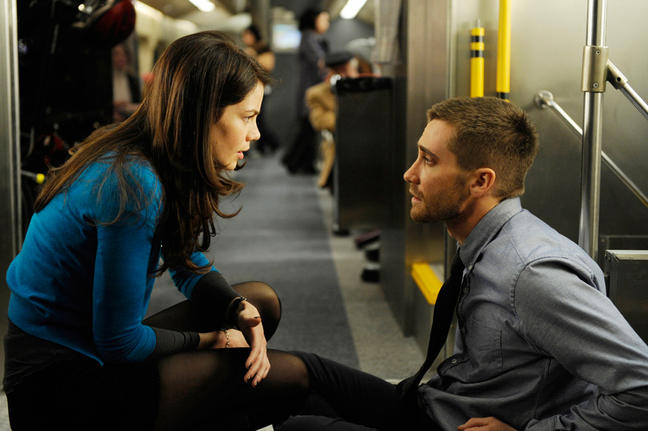
I watched Source Code for a second time and again found it to be an effective thriller that creates an alternate reality and succeeds in demonstrating it. I also enjoyed the heartfelt elements of the story involving Jake Gyllenhaal's character's relationship with his father. I also appreciated the acting more the second time around and was impressed with the work of Gyllenhaal, Vera Farmiga, and the particularly endearing Michelle Monaghan. I look forward with great anticipation to the next film from Duncan Jones.
4/3/11 A man wakes up on aChicago bound passenger train not knowing who he is, and claiming he is an Air Force captain on tour in Afghanistan . As he tries to come to terms with what's going on, he talks to a pretty young woman who seems to be smitten with him. Then suddenly an explosion rips through the train, engulfing everyone aboard whereupon the captain wakes up in a chamber as himself. He is informed that he is part of a secret mission by a secret branch of the military where he can be sent back in time into another person's body to live out their last 8 minutes with the hope that he can find the person responsible for the bombing and prevent a series a terrorist attacks. Source Code is another complex sci-fi film about multiple realities made by Duncan Jones who also brought us the fine film Moon. Here we have a high concept plot that is executed really well. We get some nice performances from Vera Farmiga as the no nonsense mission operator who may have a soft spot. Jake Gyllenhaal is effective as the captain and his short lived relationship with Michelle Monaghan is surprisingly poignant. Like Groundhog Day and Run Lola Run, films dealing with repeated time travel (though here we learn that it isn't exactly what this is) are fascinating to watch because as we become familiar with the setting it is intriguing to see how different choices affect that reality. This movie understands that and takes that to a new level.
4/3/11 A man wakes up on a
The Dreamers
In 1968 Paris, during the student riots in response to cofounder Henri Langlois' ouster from the Cinematheque Francais, a young American film buff befriends a likeminded brother and sister who have a way too comfortable relationship with each other. After the siblings' parents leave for vacation, the trio begin playing movie oriented sex games, while they ignore the riot which has taken on a new leftist meaning and keeps growing right outside their window. As the American begins to grow affectionate for the girl, he discovers that the brother may be more militant than he leads on, and she will always have an unnatural attachment to him. The Dreamers is daring and very adult filmmaking from Bernardo Bertolucci, a director who has specialized in such provocative adult geared films. Written for the screen from his novel, Gilbert Adair's work is fascinating to watch due to its movie literate script and characters, as well as its adult material which is rare to find these days where adult films are often mistaken for ones that have to do with jokes about bodily functions. Instead, we have a well written and realized film that expects a lot from its three young stars, Michael Pitt, Eva Green, and Louis Garrel, who pull off their complex roles amazingly. I felt the film lost its footing for awhile towards the midsection, but regained it for a fantastic ending. The Dreamers is challenging, stimulating, and welcome cinema when in an era when many studio offerings are none of the above.
Wednesday, July 6, 2011
Neighbors
A boy falls in love with the girl who lives on the other side of the fence of his New York City backyard. However, their hostile families prohibit them from seeing each other. What results is a sight gag filled romp as the boy attempts to court the girl despite their parents' opposition. Neighbors was one of Buster Keaton's solo films after leaving his partnership with Fatty Arbuckle, and plays off one of Keaton's favorite plots being the family feud. Neighbors is a well done slapstick that contains many wonderful stunts including a finale in which three men stand on each others soldiers, with Keaton on top, to rescue the girl from the top floor of her home, culminating in her being in his arms on the ground level. Buster Keaton's visual stunts must be seen to be believed and his comedies, including this early short, are truly one of a kind.
The Garage
Operating a firehouse and an auto repair shop out of the same building, two men engage in a series of mishaps that range from dirtying a car they were supposed to be destroying to rescuing a young lady trapped in their garage while it is burning to the ground. Before embarking on an extremely successful solo career, Buster Keaton was the sidekick to Fatty Arbuckle, who was the most famous silent comic of his time. The Garage came at a time when Keaton's career was beginning and Arbuckle's was coming to a close (due to being beset by a scandal), and is a slapstick short pulled off in very fine fashion. Demonstrating the visual gags and high risk stunts known to Keaton and Arbuckle I'm sure, The Garage is a fine example of a partnership whose members would produce the best comedies of the 1910s and 1920s.
Tuesday, July 5, 2011
Horrible Bosses
Three friends all have unimaginable employers, each a beast of a different nature: Nick (Jason Bateman) has been expecting a promotion from his anal retentive boss (Kevin Spacey) who ultimately decides to fill the position himself. Dale (Charlie Day) is being sexually harassed by the maneating dentist (Jennifer Aniston) he works for. Kurt (Jason Sudeikis) actually has a boss (Donald Sutherland) he respects, but when he kicks the bucket his coke addled son (Colin Farrell) takes over with the intention of running the business into the ground and milking the profits. Now the trio decide it is time to take the ultimate step and off their bosses. Hiring a dubious criminal (Jamie Foxx) they meet in a local dive to give them advice, they partake in a Hitchcockian plot that has unintended and unexpected results. I thought that Horrible Bosses never soars and is never the uproarious movie it thinks it is. Jason Bateman does his usual straight man bit, and Charlie Day does his Always Sunny routine, and I thought Jason Sudeikis, an actor who I'm not familiar with, was funny. Supporting players, including Spacey, Aniston, Farrell, Foxx, Sutherland, and even Ron White all have good roles but are way too underused. I would attribute the problem to a movie written by two many people (three screenwriters credited), starring too many people, that tries to give them all fair time. On top of that many of the jokes fall flat and the result is a mildly diverting film with a few laughs that probably isn't worth the price of admission.
Indiana Jones and the Temple of Doom
Just before his quest for the lost Ark, Indy narrowly escaped a melee in China with an evil crimelord with his new friends a ditzy nightclub singer and a young Chinese boy. They then narrowly escape the crimelord's plane which they've mistakenly boarded and has been set to crash. Surfacing in India, they come across a local village which has been stricken with disease which they claim is due to a Satanic cult stealing their sacred rock and their children. Now, Indy and crew embark on a deadly mission to retrieve the rock and kids and restore prosperity to the village. Indiana Jones and the Temple of Doom is a downright laughable sequel, containing none of the wit or sense of adventure from Raiders of the Lost Ark. The story is uninspired, the jokes are terrible, and Kate Capshaw and the little Chinese boy are cringe inducingly terrible. This would have been a complete loss if not for a spectacular mine chase sequence followed by a remarkable rope bridge segment, comprising the last twenty minutes of the film. But when only one sixth of a movie is great, how can you recommend it. This Indiana Jones installment is a colossal failure much worse than the recent Kingdom of the Crystal Skulls entry, and the blame should not only fall on Steven Spielberg, but also equally on George Lucas who wrote this lackluster story.
Larry Crowne
Larry Crowne works at a Walmart type superstore, is exceedingly friendly and seems to know the lay of the land. Then one day he is called into the break room where he is informed that he has been downsized due to not having any college experience (plot convenience). He attends the local community college, befriends a beautiful free spirited young woman (Gugu Mbatha-Raw), and draws the attention of his alcoholic speech teacher who has lost her passion. Larry Crowne is the second directorial effort from Tom Hanks working from a script he cowrote with collaborator Nia Vardalos. The film strives to be an upbeat recession tale in the same vein as a Frank Capra/Robert Riskin film, but oozes so much niceness and cuteness it doesn't quite achieve its goals. Stars Hanks and Julia Roberts elevate the material as best they can, but its cloying nature which I suspect can be attributed largely to Vardalos, and the fact that their attraction isn't fleshed out at all whatsoever, gets the best of them. Also, fine supporting actors are grossly underused including Bryan Cranston, Taraji P. Henson, and Pam Grier. I did go along with some of this movie and found the scenes in Roberts' classroom to be amusing as were the scenes in George Takai's economics' class. Larry Crowne is an overly earnest film that could have benefited from dialing down the cuteness and creating more authentic, well realized characters.
Subscribe to:
Posts (Atom)


